We Coded Every Actor in Trump's Last Two Addresses to Congress. Here's What Tuesday's SOTU Speech Has to Prove

Every political speech is, at its core, a story. There are heroes and villains, victims and saviors, forces of good pitted against forces of destruction. The characters in that story reveal something that traditional political analysis tends to miss: not just what a speaker says, but how they construct the world for their audience. Who gets cast in which role, how often they appear, and how their role shifts over time are all data points. And data points can be measured.
At PharosGraph, we've been developing a systematic methodology for exactly this kind of analysis. We code every actor mentioned in a political address — every person, institution, country, policy, and abstract force — as hero, villain, victim, neutral, or antihero. We then aggregate those individual codings into broader categories and examine the patterns. The result is a data-driven map of a speech's rhetorical architecture.
Ahead of President Trump's first official State of the Union address of his second term on Tuesday, February 24, we want to share what we've found by applying this methodology to his two previous major addresses to Congress: the 2020 State of the Union and the 2025 Address Before a Joint Session of Congress. The patterns are striking and they give us a concrete framework for interpreting what we're likely to hear Tuesday night.
The Numbers: How the Framing Shifted
The clearest way to see the difference between the two speeches is to look at how the same key actors were cast across them.
In 2020, a speech delivered during Trump's first term with a strong economy to celebrate, The American People were framed as heroes in 54% of their mentions and victims in only 38%. The United States as a nation was 67% hero, 11% victim. Congress appeared as 81% hero, a meaningful partner being acknowledged and celebrated from the podium.
By 2025, each of those numbers had inverted sharply. The American People: 29% hero, 57% victim. The United States: 38% hero, 55% victim. Congress: 15% hero, 77% neutral. It had been effectively demoted from partner to audience.
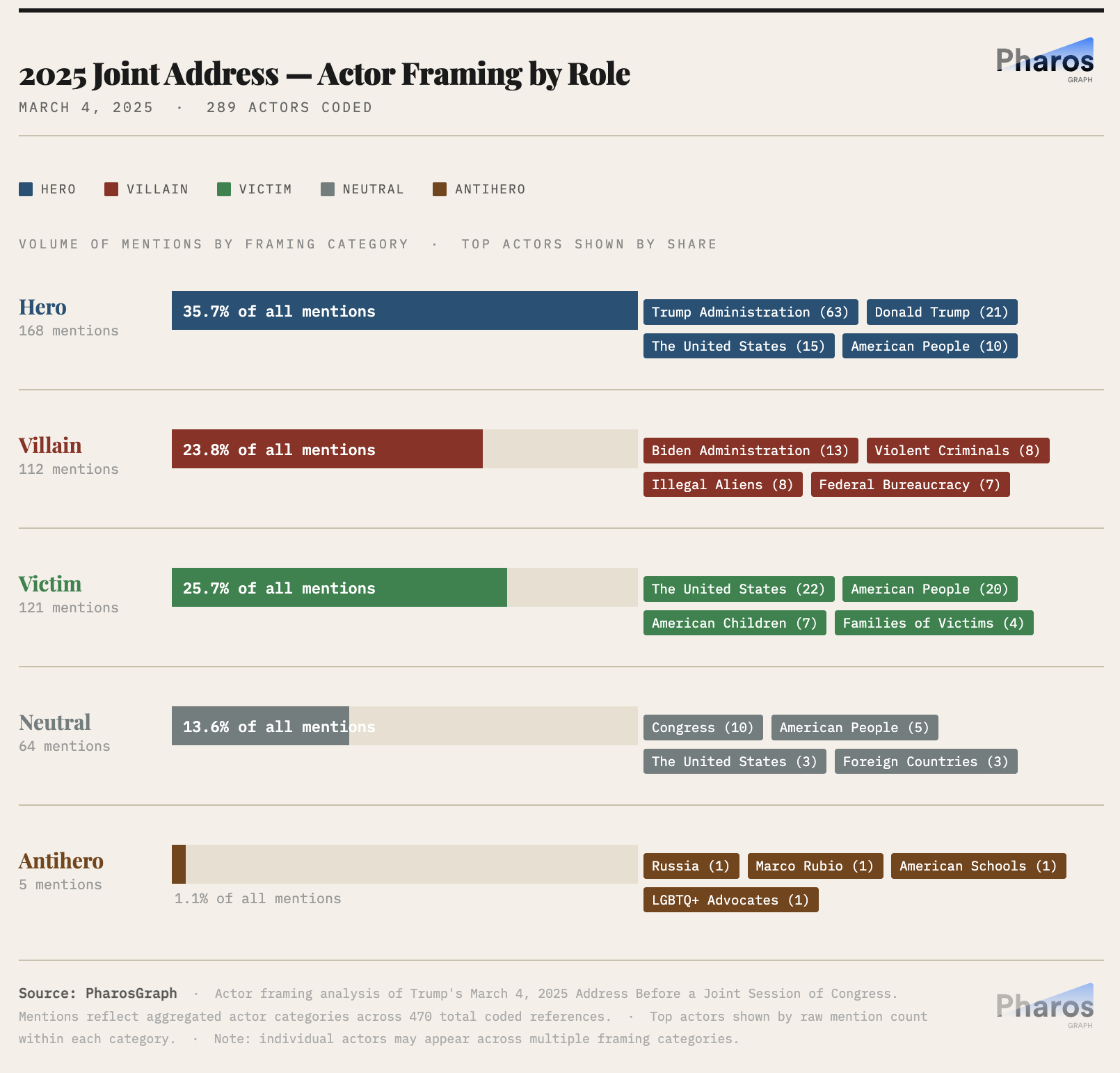
Across 470 total coded actor mentions in the 2025 joint address, heroes accounted for 35.7% of all mentions, victims for 25.7%, villains for 23.8%, and neutral actors for 13.6%. The villain roster was led by the Biden Administration (13 mentions), Violent Criminals (8), Illegal Aliens (8), and the Federal Bureaucracy (7). On the hero side, the Trump Administration dominated with 63 mentions, more than three times any other single actor.
In short: between 2020 and 2025, the nation went from thriving to suffering, the people went from empowered to endangered, and the administration went from steward of prosperity to lone rescuer of a wounded country.
The Crisis Narrative Meets a Complicated Reality
This is the central rhetorical tension heading into Tuesday's address. The 2025 joint address was built on a coherent and deliberate structure: the nation as victim, the administration as rescuer, the crisis as justification for aggressive action. It was powerfully suited to a president one month into his second term — one who had been gone for only four years and returned to find, by his own account, a country unrecognizable. The implicit logic is striking: not decades of drift but one administration, one man, bearing singular responsibility for the wreckage. In Trump's rhetorical world, Biden wasn't just a failed predecessor; he was the efficient cause of everything broken.
But a year on, the political context has shifted considerably. Trump's approval ratings have trended downward since the highs of his inauguration, and polls consistently show a majority of Americans believe the administration's actions have fallen short of expectations, with independents showing particularly meaningful erosion.
This makes Tuesday's address unusually high-stakes as a piece of political communication. With midterm elections approaching and House margins razor-thin, the SOTU is the single largest platform Trump will have to frame his first year back in office for a mass audience: to define what was accomplished, who deserves credit, and what remains unfinished.
The traditional State of the Union carries expectations of stock-taking and affirmative vision. But doing that authentically requires a shift away from the crisis framing that has defined Trump's rhetorical posture throughout his second term. Sustaining pure crisis framing a full year in begins to raise an uncomfortable question: if everything was broken when you arrived, and you've had a year to fix it, who is responsible for the present? It's going to be a tough job balancing victory with blame.
Friday's Supreme Court ruling striking down the IEEPA-based tariffs complicates that calculus further. Tariffs were among Trump's most signature domestic achievements, cast as a pure hero actor in our 2025 analysis. The 6-3 ruling, written by Chief Justice Roberts, does not eliminate all tariffs, but it invalidates the emergency-powers framework that underpinned the most sweeping of them. The question Tuesday night is not just how Trump addresses the ruling itself, but how he reframes the broader economic narrative when one of its central instruments has just been legally dismantled days before the speech.
Villain Landscape: Inward in 2025, Outward in Practice. What Happens in 2026?
One of the clearest trends in our data is the expanding and inward-turning villain roster. In 2020, the primary villains were foreign: the Iranian regime, Nicolás Maduro's Venezuela, ISIS, al-Baghdadi, Soleimani. The domestic villain list was relatively sparse. By 2025, a dense layer of internal institutional enemies had been added: the Federal Bureaucracy, DEI Policies, Wokeness, the Radical Left, Sanctuary Jurisdictions, and the absent federal workforce, all cast as forces undermining the national interest from within.
Yet there is a striking tension between that rhetorical posture and the actual foreign policy record of the past year. The administration has in practice been extraordinarily active internationally, arguably more so than in the first term, and more so than many of his own supporters anticipated or wanted. The capture and extradition of Nicolás Maduro. Military operations in Venezuela. A heightened posture toward Iran. The Gaza reconstruction plan. Ongoing engagement on Ukraine. Pressure on Greenland and the Panama Canal. The administration has imposed tariffs on allies, threatened to seize sovereign territory, and proposed an International Board of Peace as an alternative to existing world institutions, reshaping the post-WWII order in ways that have unsettled traditional allies and adversaries alike.
How does this international record get narrativized on Tuesday? The Maduro capture is likely to be a centerpiece: a foreign villain defeated, a socialist regime dismantled, perhaps with Venezuelan people recast as liberated victims, consistent with how Trump framed oppressed foreign populations in 2020. But the broader foreign policy portfolio is harder to package neatly. Tariff disputes with allies, NATO tensions, the Ukraine situation, and military interventions conducted without prior congressional approval all create rhetorical complications. The foreign villain category may actually narrow in specificity to a few clear wins, while the domestic institutional villain cluster continues to expand.
Congress: Neutral by Design, or Nervous by Circumstance?
The collapse in Congress's hero framing, from 81% in 2020 to 15% in 2025, reflects more than just rhetorical style. It reflects a governing reality: a Republican-controlled Congress that critics argue has largely functioned as an extension of executive will rather than as a co-equal branch exercising independent judgment. With a slim House majority of 218 seats, near-unanimity has been not just politically convenient but structurally necessary. The neutrality in our data captures something telling. Congress has been in the room but not quite in the story.
That dynamic may be shifting, however tentatively. Rep. Thomas Massie recently observed that the "retirement caucus is growing," with dozens of GOP members opting not to seek reelection ahead of the midterms, and suggested that once spring primaries pass, more defections will follow. Vulnerable Republicans in swing districts are beginning to calculate their own political survival independently of the president's priorities. And with Friday's Supreme Court ruling now requiring an act of Congress to restore the tariff framework, the administration suddenly needs legislative partners in a way it hasn't for much of the past year.
Watch whether Congress moves from neutral bystander back toward hero framing on Tuesday, and whether there is an explicit legislative ask embedded in the speech that implicitly requires rehabilitating Republican members as collaborators rather than passengers.
The Justices in the Front Row
One of the State of the Union's most distinctive stagecraft elements is the presence of Supreme Court justices in the front rows of the House chamber, a tradition that places the nation's highest judicial officers as a live audience for the president's address to Congress. This Tuesday, several of the justices who voted on Friday to strike down Trump's IEEPA tariffs will be seated directly in front of him.
Chief Justice Roberts, who authored the 6-3 majority opinion, will almost certainly be among them. Trump called the ruling "a disgrace" within hours of it being handed down. Whether he acknowledges the court's presence, ignores it pointedly, or uses the moment for a direct rhetorical challenge will itself be a data point worth watching.
More broadly, Friday's decision is part of a larger pattern. While the conservative-majority Supreme Court has been broadly receptive to Trump's claims of presidential authority in emergency applications, the tariff ruling marks the first time it has delivered a final, definitive "no" on a core administration policy. And it is not only the Supreme Court: Republican-appointed judges and even Trump-appointed lower court judges have repeatedly issued injunctions blocking administration priorities throughout the past year. At every level, the judiciary is becoming a credible new villain category in the administration's rhetorical universe, joining the federal bureaucracy and unelected officials as institutional obstacles to executive will.
Biden as Villain: How Long Can He Carry the Weight?
In the 2025 speech, the Biden Administration was the single largest villain actor by raw mention count: 13 appearances, more than any other individual villain category. Biden personally appeared 5 times as a villain. Together they functioned as a kind of perpetual explanation: the source of everything broken, the reason emergency action was justified, the shadow against which the current administration defined itself.
A year in, that framing faces a different kind of political pressure. Sustained blame of a predecessor can begin to read as an admission that the present is still unsatisfactory, which is exactly the impression a president with declining approval ratings cannot afford to reinforce ahead of midterms. There is a reasonable case that Biden's rhetorical role should diminish in 2026, replaced by forward-looking claims of achievement.
And yet Trump's rhetorical style is not built for ownership of the present when the present is complicated. The question is less whether he will blame Biden and more whether Biden will remain the primary target, or whether the blame portfolio diversifies: to the courts, to Congress's obstruction, to foreign actors, to the deep state. Watch not just how often Biden is mentioned, but how his mentions are framed: as historical context for current policy, or as active causal agent for ongoing problems.
The Wild Cards: What We're Also Watching
Beyond the structural dynamics, several acute storylines heading into Tuesday warrant specific attention in our analysis.
The Epstein files. The DOJ missed its December deadline for the full file release, and subsequent releases have been controversial, revealing powerful figures, thousands of references to Trump himself, and failures to redact victims' names. The issue has become a significant political liability, driving a public break between Trump and some of his most loyal former allies. Former Rep. Marjorie Taylor Greene has described Trump's handling of the files as "the biggest political miscalculation in Donald Trump's career," and Rep. Thomas Massie has made the issue central to his ongoing confrontation with the White House. Does Trump address this directly, ignore it entirely, or attempt to reframe it? Any choice will be analytically significant.
Republican dissent. Massie has framed himself as a test case for whether Congress can exercise independent judgment, and Trump has backed a primary challenger against him in what is shaping up as a referendum on intraparty loyalty. With Greene gone from Congress and a growing retirement caucus, the question of how Trump addresses, or conspicuously ignores, Republicans who have broken with him will signal how he intends to manage the party heading into the midterms. Does the SOTU attempt to bring wavering members back into the fold, or does it treat loyalty as assumed and punishment as implicit?
Midterms, elections, and redistricting. The 2026 elections hover over every aspect of this speech. How Trump constructs the electoral stakes — which achievements anchor the Republican case, which villains motivate the base, which vulnerabilities get papered over — will shape the speech's political architecture as much as any policy agenda. The redistricting cycle adds a further layer: how the congressional map gets drawn in the coming months will be influenced in part by the political climate this speech helps set.
Full Rapid-Response Analysis: Tuesday Night
We will be publishing our complete actor framing analysis of the 2026 State of the Union on Tuesday night, as rapidly as possible after the speech concludes. That will include the full coded dataset, category-level distributions, top actors by role, and a direct comparison with both the 2020 and 2025 numbers laid out here.
The key questions we'll be answering in real time:
- Does the American People's framing shift from majority victim back toward hero, signaling a genuine pivot to a victory narrative?
- How many distinct villain categories appear, and does the judiciary emerge as an explicit new domestic institutional villain for the first time?
- How is Biden mentioned: active causal agent or fading historical context?
- How are tariffs framed: surviving achievement, martyred policy, or congressional call to action?
- What do the named guest "props" signal: inspiration and achievement, or grief and grievance?
- Does Congress get rehabilitated as a partner, and does the speech contain an explicit legislative ask?
- How, if at all, does Trump address the Epstein files, Republican dissent, and the midterm electoral landscape?
Political speeches are stories. The casting choices are the data. Tuesday night, we'll be reading both closely.
PharosGraph applies systematic actor framing methodology to political communication. Our analysis of the 2025 joint address is based on 470 coded actor mentions across aggregated actor categories. Our 2020 SOTU analysis draws on a comparable dataset from that address. Full methodology available on request.


The Suburban Bloc That Could Swing the 2026 Texas Senate Race

What Local TV Ad Sales Teams Are Missing in Political