
Re-imagining the American Dream: Why Voters Seek Heroes When the Old Story No Longer Holds

For nearly a century, the American Dream functioned less as a description of reality and more as a unifying fiction. It was an inspirational story that offered coherence and direction even when lived experience contradicted it. This tension was never invisible. As far back as Mark Twain's Huckleberry Finn, the gap between the Dream's ideal of freedom and the country's actual moral landscape was exposed with cutting clarity. Huck's journey reveals a society that celebrates liberty while normalizing cruelty, hierarchy and exclusion. The Dream promised universality, yet its benefits were never shared universally.
Despite these contradictions, the Dream endured because it provided a narrative architecture that absorbed complexity. It offered people a way to interpret effort, responsibility and belonging. It reconciled the difficulty of modern life with the belief that one's actions could shape the future. Even if the Dream was never fully true, it was narratively stabilizing.
But today that stabilizing fiction is collapsing. As the old story loses its coherence, a vacuum is opening in American civic life. Populism rises by exploiting intuitive frustrations, while a different pattern emerges among successful non-populist leaders: candidates framed as "heroes" who offer clarity, agency and moral structure inside a world that feels overwhelming. In our recent work at PharosGraph, where we mapped narrative roles across tens of thousands of LLM responses, news articles, posts and blogs, we found that candidates who occupied the hero role most consistently were also the ones who won in 2025's major races.
This piece builds on that insight, connects it to Joseph Heath's argument about "populism fast and slow" and leads us to ask whether the rise of hero-framed leaders signals the early construction of a new, more humane American Dream.
The American Dream as a Useful Fiction
To understand what is failing now, we must acknowledge what the Dream actually was. It was not a reliable social contract. It was a narrative technology that performed several cognitive and emotional functions, it offered:
- Agency: the belief that individual effort mattered
- Moral coherence: the sense that the world rewarded virtue rather than randomness
- Institutional navigability: the impression that systems, though imperfect, were workable and just.
- A red thread that tied effort to progress
This was not the unanimous experience of Americans. Twain made that clear. The Dream excluded entire communities and operated with a long list of unspoken conditions and disclaimers about who could access opportunity and under what terms. It relied on a selective reading of national life that flattened contradictions and erased the barriers many groups faced. Yet it remained powerful because it translated a confusing world into a moral and comprehensible one. The Dream reconciled fast, intuitive cognition with the slow, effortful demands of institutional life. It allowed people to feel that the promise made sense even when the details did not.
Recent reporting in the New York Times exploring immigrant experiences reinforces this point. This survey shows that many immigrants have long viewed the Dream differently from the dominant narrative. For them, the barrier has rarely been effort or aspiration; it has been the complexity of systems that are hard to navigate and slow to reward newcomers. These perspectives reveal that the Dream's promise was always unevenly distributed, and that large parts of the population never accessed the straightforward path it claimed to offer. As the Dream's credibility erodes for a wider share of Americans, the unevenness becomes harder to ignore.
What is failing now is not the fairness of the system but the believability of the fiction that once made the system sufficiently fair.
The Collapse of the Narrative Order
The American Dream has not disappeared from rhetoric, but it no longer functions as a stabilizing story. The mismatch between narrative and lived reality has widened to the point of fracture. For much of the twentieth century, the Dream held together because a broad middle class lived close enough to its promise to make it believable. When enough people appeared to be achieving it, the myth reinforces itself. But as the middle class contracts and more Americans find themselves merely imagining the Dream rather than experiencing it, the gap becomes impossible to ignore. A Dream that once felt attainable now feels aspirational, and people are starting to wake up from it.
People experience this collapse not only economically but cognitively:
- Managing a household requires constant vigilance and expertise.
- Navigating healthcare or education demands specialized knowledge.
- Bureaucratic environments penalize mistakes harshly.
- Social media platforms accelerate information faster than people can process it
All of these elements add to individuals cognitive burdens as the link between required personal effort and basic stability feels increasingly unpredictable. As Heath notes, modern life demands a level of attention, interpretation and self-regulation that were once the sole domain of highly specialized individuals or "elites". These Elites take the cognitive demands for granted simply because they are fluent in them. The majority of people are not. The result is resentment towards systems, institutions and the people who appear to manage them effortlessly.
Twain would recognize this resentment. He understood that societies cling to myths until they become cognitively bearable. When fiction can no longer hold, people reach for new stories to make sense of their world. Populism and hero-framed leadership are two such responses.
Populism as the Fast-Thinking Substitute for a Broken Dream
Populism does not offer a new Dream. It offers a shortcut that eliminates the cognitive and moral strain created by institutional complexity. It replaces the collapsed narrative with intuitive binaries:
- People versus elites
- Common sense versus expert thinking
- Strength versus weakness
- Loyalty versus betrayal
- Punishment versus permissiveness
Populism succeeds by the slow-thinking demands of modern life. It tells people they are right to feel burdened and that fault lies with elites who insist on abstract, effortful forms of reasoning. This is kind of reasoning that tries to explain why modern life is so demanding in the first place and often proposes complex, sometimes counter-intuitive solutions that require attention and patience to grasp. Populism avoids all of that. It resonates because it uses the cognitive style that people default to when the world becomes overwhelming: intuitive, emotional and morally certain.
But populism cannot construct a coherent replacement for the American Dream. It provides clarity but not direction. It generates agency through anger rather than progress. It simpifies the world but does not rebuild it.
For that, voters often turn to something more constructive: the hero.
The Rise of the Hero Candidate
In our analysis of the 2025 elections, the winning candidates were those consistently framed as heroes. They were cast not merely as competent administrators but as protagonists in a landscape that no longer has a trusted guiding story.
A political hero performs several functions that echo the Dream's old narrative role. They:
- Absorb complexity so other do not have to.
- Turn institutional power into visible agency.
- Provide a moral red thread in a confusing landscape.
- Reconcile intuitive and analytic worlds.
- Personalize accountability within systems that feel abstract.
These functions are not symbolic. They are cognitive and narrative in nature. They help people navigate a world where institutions are opaque and the old stories no longer fit.
Hero candidates succeed because they translate complexity rather than deny it. They offer agency without scapegoating. They provide coherence without requiring ideological purity. Their rise is not about personal charisma but about narrative necessity.
In a society that has lost its shared protagonist, individual political actors who can occupy that role become unusually powerful meaning-makers.
Why Hero Framing Works When the Dream Fails
People do not simply want leaders who solve problems. They want leaders who make the world intelligilble. When the Dream functioned as a national myth, it played that role. Today, individuals must.
Hero-framed leaders resonate because they:
- Acknowledge the cognitive burden Americans feel.
- Speak in a way that feels intuitive without being simplistic.
- Do not dismiss frustration as ignorance.
- Make institutions feel human again.
- Offer a believable path between present difficulty and future stability.
In other words, they restore the sense that the story still has a red thread. Twain exposed the hypocrisy of the original Dream, but he also understood that people need narrative coherence. The collapse of the Dream leaves a vacuum that must be filled by new forms of meaning-making.
Toward an Evolved American Dream
If the old American Dream was always partly myth, the the future does not require a restoration but an evolution. A new foundational narrative must be more honest about complexity and more humane about cognitive burden. A viable successor must integrate:
- Structural realism
- Narrative agency
- Institutional humility
- Cognitive empathy
- Shared responsibility
This new Dream cannot rely on the old formula of upward mobility through individual effort alone. It must offer navigability: the ability to move through complex systems without being overwhelmed. It must accept that fairness is not self-executing but must be deliberately designed. And it must place human agency at the center without indulging the fantasies of populist strongmen.
Heroes as Early Architects of the Next Story
Hero framed leaders are doing more than winning elections. They are demonstrating what a new narrative architecture could look like. They are prototypes, not saviours. They show how leaders can balance realism with hope, complexity with coherence and institutional strength with human relatability.
In this sense, they may be the early builders of a new American Dream. Not one that pretends injustice never existed, but one that offers dignity in a cognitively demanding world. One that does not promise simplicity, but one that makes complexity navigable. Not one that erases the contradictions that Twain exposed, but one that acknowledges them openly and still points towards progress.
The old Dream promised upward mobility. The next Dream may promise intelligibility. It may refine freedom not as escape from constraint but as the ability to live without being crushed by systems that make sense only to experts.
Whether this new dream emerges will depend on leaders who can integrate narrative agency with institutional reform. But one thing is clear. Americans are searching for meaning-makers again. They are seeking figures who can carry the story forward when the old fiction has finally become untenable.
And in that search lies the outline of a new American story.

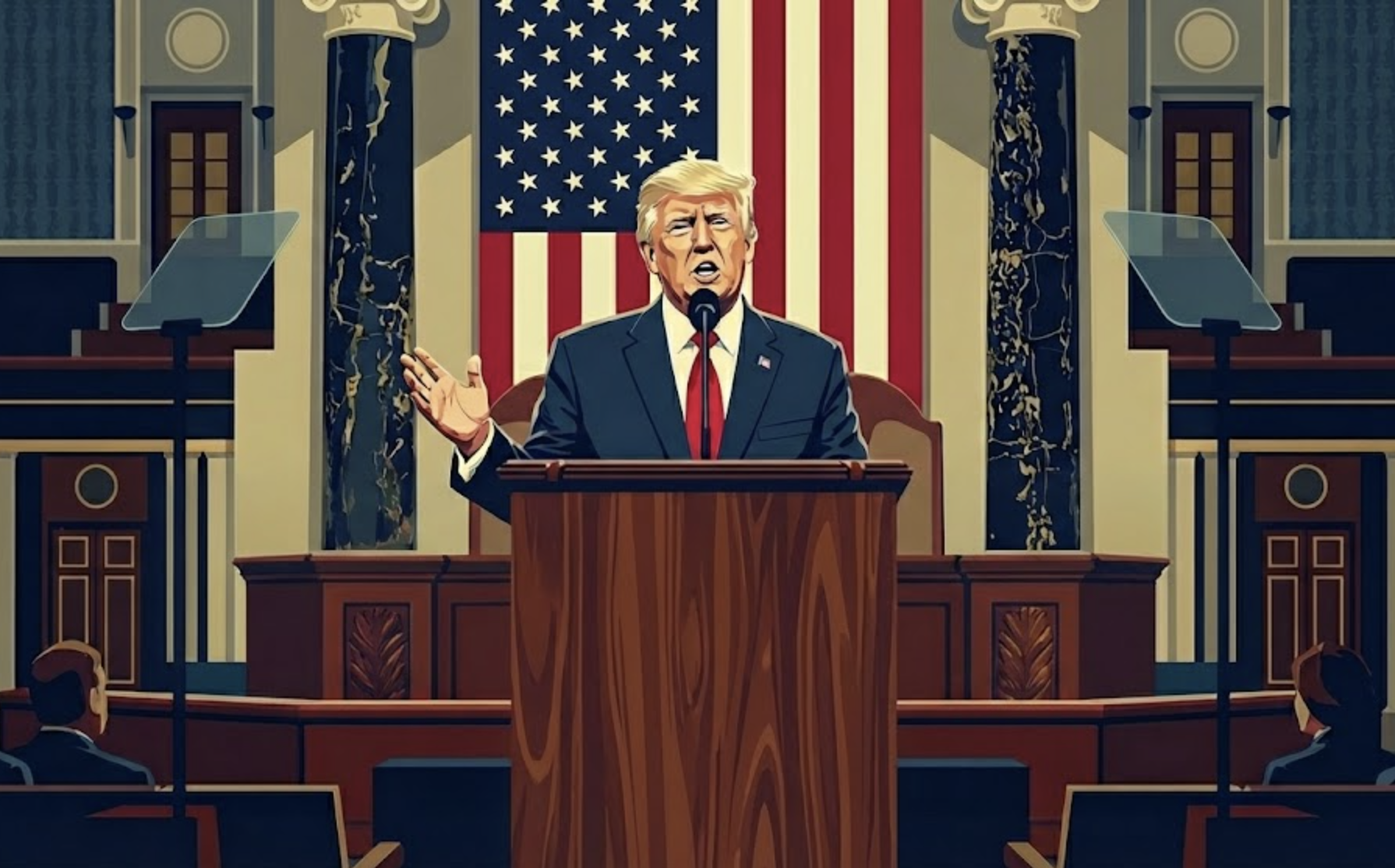
A Nation Winning, a People Still Suffering. We Coded Every Actor Trump Mentioned in his 2026 SOTU

We Coded Every Actor in Trump's Last Two Addresses to Congress. Here's What Tuesday's SOTU Speech Has to Prove