A Nation Winning, a People Still Suffering. We Coded Every Actor Trump Mentioned in his 2026 SOTU
Every State of the Union is a story. But whose story it is, who gets cast as hero, who carries the blame, who the president defines as the enemy, tells you more about the political moment than any policy proposal. We code those choices systematically, and last night's speech produced some of the most striking data we've seen across three Trump addresses to Congress.
Here's what we found.
The Method, Briefly
For those new to our work: PharosGraph applies a systematic actor framing methodology to political speeches. Every actor mentioned in an address, every person, institution, country, policy, and abstract force, is coded as hero, villain, victim, neutral, or antihero. We aggregate those individual codings into canonical categories, run the numbers, and compare across speeches. Our database covers every State of the Union address back to Franklin Roosevelt. For this analysis, we focused on Trump's three most recent major addresses to Congress: the 2020 State of the Union, the 2025 Address Before a Joint Session of Congress, and last night's 2026 State of the Union. Last night's address yielded 398 total coded actor mentions.
The three-speech arc tells a coherent and, in some respects, surprising story.
The Headline Finding: The American People Are More Victimized Than Ever
The single most diagnostic variable across all three speeches is how Trump frames the American People, and the trajectory is striking.
In 2020, more than three years into his first term and heading into a presidential election he was favored to win, Trump spoke from a position of economic strength. The American People were cast as heroes in 54% of their mentions and victims in 38%. The speech had the texture of a victory lap: a people empowered, a country thriving, an administration delivering results. Exactly the framing you would expect from an incumbent building the case for a second term.
By 2025, one month into that second term, the framing had inverted sharply. The American People: 29% hero, 57% victim. The United States as a nation: 38% hero, 55% victim. The story had become a crisis narrative. A nation wounded, its people endangered, awaiting rescue.
The question heading into last night was whether a full year in office would begin to ease that framing. Whether the crisis would give way, at least partially, to a story of restoration. And with the 2026 midterms approaching, elections that will determine whether Trump can sustain a working congressional majority and with it the legislative architecture of his agenda and his legacy, the pressure to pivot toward a victory narrative was significant.
It didn't happen. The crisis deepened.
In the 2026 State of the Union, the American People were coded as victims in 67% of their mentions, the highest victim share across all three speeches. Hero mentions fell to 16%. A year into his second term, with a crucial midterm on the line, Trump's rhetorical construction of the American People is more victimized than at any point since we began measuring. The rescue, in his telling, is still very much in progress.
The Nation Recovers. Its People Do Not.
Before going further into the villain landscape and structural shifts, one finding deserves its own moment, because it is the tension that runs through the entire speech.
The United States as a nation recovered significantly toward hero framing last night: 57% hero, 14% victim. Much closer to 2020 levels (67% hero, 11% victim) than to the crisis framing of 2025 (38% hero, 55% victim). Trump opened the speech by declaring, "Our nation is back — bigger, better, richer and stronger than ever before." The country, as an abstract entity, is winning again.
The American People tell a different story: 16% hero, 67% victim.
A nation being made great again, but whose people are more imperiled than ever. A country winning abroad and recovering at home as an institution, but whose citizens remain primarily sufferers. This divergence, the nation rising while its people remain victimized, is one of the most analytically distinctive structural features of the 2026 speech, and it is visible throughout the guest list. Of roughly 20 named guests in the chamber, approximately 60% were there to represent grief or grievance: parents of soldiers killed in the line of duty, mothers of victims of violent crime, families displaced by open-border policies. The remaining 40% represented inspiration, veterans, athletes, economic success stories. The ratio mirrors the data.
Category Distribution: A More Complex Rhetorical World
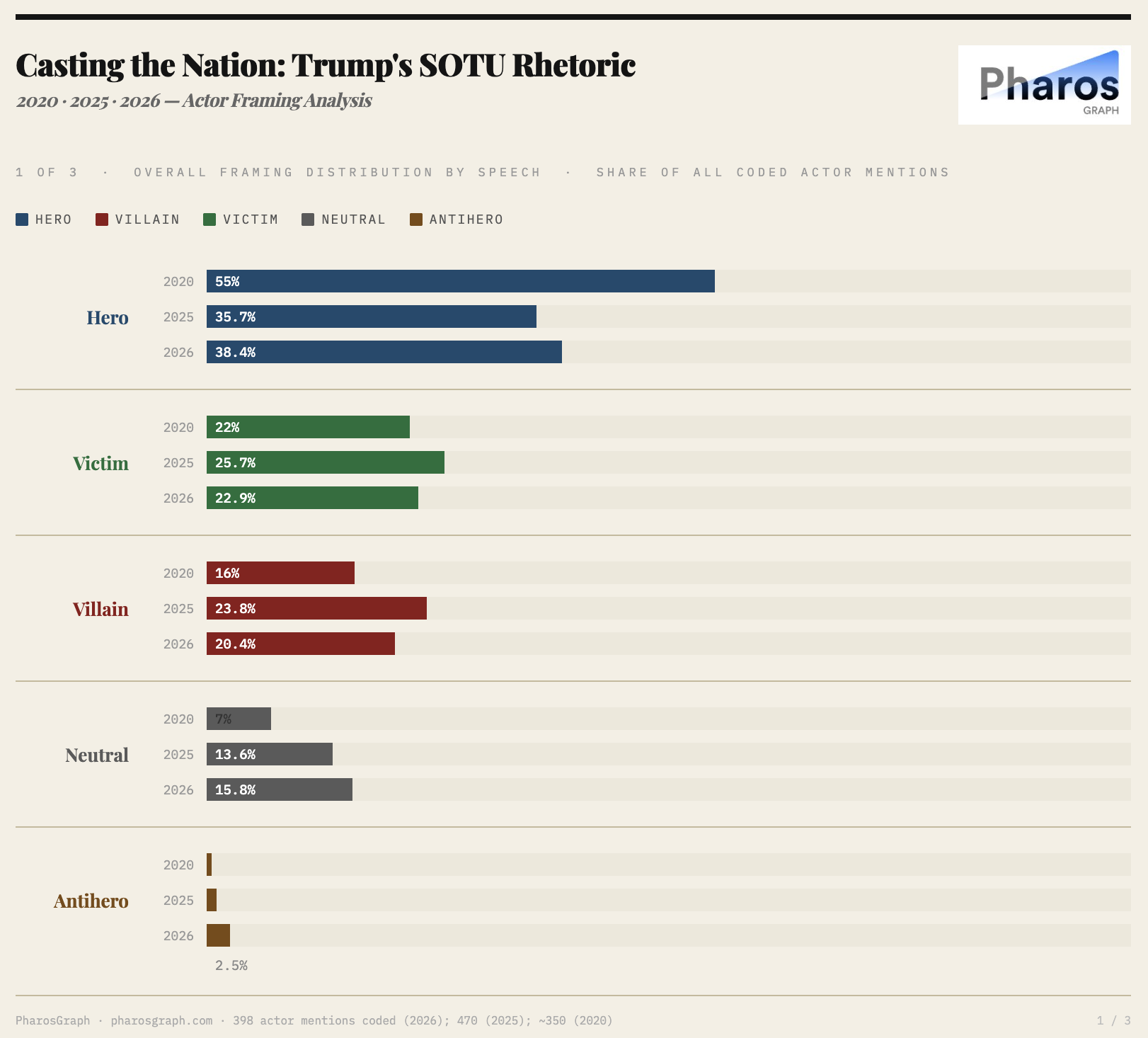
Across the 398 coded mentions in the 2026 address, the overall distribution was:
Hero: 38.4% (153 mentions) · Victim: 22.9% (91) · Villain: 20.4% (81) · Neutral: 15.8% (63) · Antihero: 2.5% (10)
Hero framing ticked up slightly from 2025 (35.7%), consistent with an administration presenting accomplishments alongside the ongoing crisis narrative. Villain framing came down from its 2025 peak (23.8%). Both movements fit a partial pivot toward an achievement narrative.
The more interesting shifts are in the tails. Neutral mentions continue to grow, from 7% in 2020 to 13.6% in 2025 to 15.8% last night, reflecting a speech increasingly populated by actors who resist clear moral assignment. And the antihero category doubled, from 5 mentions (1.1%) in 2025 to 10 (2.5%) last night. More on that below.
The Supreme Court: The Sharpest Reversal in the Dataset
In 2025, the Supreme Court appeared once in our coding, and it was a pure hero mention. Last night, it appeared twice, and both mentions were villain.
That is a complete reversal from 100% hero to 100% villain in a single year, driven directly by the 6-3 ruling last Friday that struck down Trump's IEEPA-based tariff framework. Trump's language in the speech was pointed: "an unfortunate ruling from the United States Supreme Court... very unfortunate ruling." He called it "disappointing" twice. He had called it "a disgrace" within hours of it being handed down on Friday.
This is the starkest single-actor shift in our three-speech dataset. And it completes a pattern worth naming explicitly: with each successive speech, the villain roster has expanded to include another layer of American institutional life. In 2020 the villains were primarily foreign. In 2025, the Federal Bureaucracy, DEI infrastructure, and sanctuary jurisdictions were added as domestic institutional enemies. Last night, the Supreme Court joined that list for the first time.
The judiciary is now an explicit villain actor in Trump's rhetorical universe. The pattern also extends beyond last Friday's ruling. Throughout the past year, Republican-appointed and even Trump-appointed lower court judges have issued rulings blocking administration priorities at every level. The courts as a whole, not just one decision, are coalescing into a stable villain category, joining the federal bureaucracy and unelected officials as institutional obstacles to executive will.
Villain Landscape: Foreign Threats Return, Biden Persists
The top villain actor in last night's speech, at 11 mentions, was a broad cluster of foreign threats and terrorism: the Afghan terrorist who killed National Guard Specialist Sarah Beckstrom, the Iranian regime and its proxies, Soviet-era fighter pilots in the Royce Williams story, enemy combatants in the Venezuela raid, and general foreign adversaries. This is a significant reversal from 2025, when foreign threats receded as domestic institutional villains dominated. Last night they surged back to the top, overtaking even the Biden Administration. The inward villain turn of 2025 has partially, though not entirely, reversed.
The Biden Administration remains firmly entrenched as the #2 villain actor, at 10 mentions. A full year into Trump's second term, the inherited disaster framing has not faded. Biden is not receding into historical context. He remains an active causal agent for ongoing problems, the efficient cause in Trump's construction of everything that still needs fixing.
Undocumented immigrants, whom Trump consistently calls "illegal aliens" throughout the speech, a language choice that is itself a framing decision collapsing legal status into moral character, appear 8 times as villains, unchanged from 2025. But the more notable pattern in the transcript is how persistently the speech conflates undocumented status with violent criminality. The Dalilah Coleman story, the Lizbeth Medina story, the broader passage about "murderers, 11,888 murderers" who "came into our country": in each case, the undocumented immigrant and the violent criminal are the same figure, or positioned as inseparable. This conflation is deliberate and structural, not incidental. It appeared 8 times as undocumented immigrant villain and 7 times as violent criminal villain in our data, but in the rhetorical architecture of the speech they function as a single composite threat.
The Federal Bureaucracy drops slightly from 7 mentions in 2025 to 5, and DEI Policies decline as well. The domestic institutional villain layer is receding at the margins but has not been dismantled.
Congress: Still Neutral, But More Adversarial
In 2020, Congress was 81% hero. In 2025, that collapsed to 15% hero, 77% neutral. Congress had been effectively demoted from partner to audience.
Last night, Congress's hero share ticked up slightly to 21%, reflecting Republican members celebrated for specific votes, particularly the "Great Big Beautiful Bill." But the more significant movement is at the other end: Congress's villain share rose from 8% in 2025 to 21% last night. One in five Congress mentions was adversarial, directed primarily at Democrats blocking DHS funding and sustaining the government shutdown.
That near-tripling of the villain share tracks with the political dynamics of the moment. Democratic opposition to the DHS funding bill featured prominently, and Trump demanded from the podium "the full and immediate restoration of all funding for border security." The neutrality of 2025 is giving way to something more complicated: a chamber partially rehabilitated as a partner and partially cast as an obstacle.

The Antihero Expansion: Where the Speech Got Complicated
The doubling of antihero mentions, from 5 in 2025 to 10 last night, is the most analytically subtle finding of the night, and the transcript puts specific flesh on those numbers.
Democrats (3 antihero mentions) landed as antihero rather than pure villain in three specific moments: when some Democrats stood for the insider trading legislation ("Let's pass the Stop Insider Trading Act without delay"), when Trump called for bipartisan unity in the wake of Charlie Kirk's death ("we must all come together to reaffirm that America is one nation under God"), and during the drug pricing section where he sought cross-aisle agreement. In each case, Democrats were cast as capable of cooperation, ambiguous rather than purely oppositional.
Hamas (1 antihero) is the most striking individual entry. During the hostage recovery section, Trump said: "Hamas worked along with Israel and they dug and they dug and they dug," describing their role in locating the bodies of the final hostages. An organization that is a designated terrorist group appeared, in this specific moment, as a working partner. Not celebrated, but not condemned in that passage either. It is a genuinely unusual piece of framing that our methodology captures.
NATO and allies (1 antihero) reflected the same ambiguity: "NATO countries, our friends and allies, have just agreed at my very strong request to pay 5 percent of GDP." Celebrated for compliance, but with the embedded criticism that they weren't paying before. A backhanded compliment that resists clean hero framing.
Donald Trump himself (2 antihero mentions) is the first time in our dataset Trump has been coded in any role other than hero or victim. Both were off-script self-referential moments: "This should be my third term, but strange things happen," and, during the Medal of Honor ceremony, "I've always wanted the Congressional Medal of Honor, but I was informed I'm not allowed to give it to myself." Humor, self-awareness, and an implicit acknowledgment of constitutional constraint. In a speech that otherwise projects unchecked authority, these moments read differently in the data.
The Administration Shrinks. Trump Grows. Rubio Rises.
One more data point worth examining carefully: the Trump Administration appeared 31 times in 2026, down from 64 times in 2025. At the same time, Donald Trump personally appeared 32 times. For the first time in our dataset, Trump as an individual outpaces his own administration in raw hero mention count.
The personalization of power is visible in the framing data. The collective "we" of 2025 is giving way to a more emphatic "I."
This is worth thinking about in the context of political succession. Trump cannot run again. At some point the Republican Party will need a successor, and that successor will need to be elevated. The shift away from the administration as a collective hero and toward Trump as a singular one moves in the opposite direction from succession-building. Whether that reflects deliberate reluctance, simple ego, or the rhetorical habits of a president who has always personalized everything, the data captures it clearly.
The named members of the administration who did receive explicit hero framing offer their own signal. Marco Rubio received the warmest extended praise of any named official, "I think he'll go down as the best ever," and was described as an autonomous force for good in his own right. JD Vance was assigned leadership of the new war on fraud. Steve Witkoff and Jared Kushner were credited by name for the hostage deal, with Rubio named as the principal they report to.
What is notable in the pattern is what is absent. No DOGE figures by name. No domestic policy leads. No cabinet secretaries other than Rubio. The named hero cluster within the administration is almost entirely concentrated in foreign policy and national security, the domain where Trump's claimed achievements are clearest and the actors are most easily cast as warriors.
Charlie Kirk, the Guest List, and the Martyrdom Frame
One of the night's most analytically significant moments came in a section on religious renewal, when Trump said: "Had to do with my great friend Charlie Kirk, a great guy, great man. So last year Charlie was violently murdered by an assassin and martyred, really martyred for his beliefs."
Kirk is coded in our data as both hero and victim, the only named guest in this speech who occupies both roles simultaneously. Trump's use of the word "martyred" is deliberate and unusual: it elevates a conservative media figure to a category of political-religious sacrifice, invoking his death in the same register as soldiers who die in service to the nation. The moment was used to call for unity across partisan lines, one of the few times in the speech Trump explicitly sought Democratic buy-in, which is why it also anchors some of the antihero framing of Democrats noted above.
Beyond Kirk, the guest list as a whole tells the same story the data tells. Of roughly 20 named guests in the chamber, the majority were there to represent loss: Sarah Beckstrom's parents, Lizbeth Medina's mother, Iryna Zarutska (whose daughter was murdered on a Charlotte train), Dalilah Coleman (struck by a truck driven by an undocumented immigrant), the family of Andrew Wolfe. The heroic counterweights, Eric Slover, Scott Ruskin, the hockey team, the veterans, Michael and Susan Dell, were present and celebrated. But the emotional weight of the room was calibrated toward grief. That is not accidental. It is the guest list as a physical expression of the victim framing that runs through the entire dataset.

The Three-Speech Arc
Step back from any single finding and the three-speech arc has a coherent shape.
In 2020, Trump told a story of a country being restored to greatness. A campaign-mode victory lap, delivered by an incumbent seeking reelection with a strong economy behind him. The American People were empowered participants. The villains were foreign. The heroes were everywhere.
In 2025, the framing inverted: a country devastated by four years of misrule, a people victimized, a lone administration fighting to rebuild. The villains turned inward toward domestic institutions. The nation and its people were both suffering.
In 2026, the pattern shifted again, partially. Foreign threats returned to the top of the villain list. The nation as an institution began recovering toward hero framing. Trump himself emerged as a more singular, personal hero than in either previous speech. But the American People remain more victimized than at any point in the dataset. Biden remains a top-tier villain a full year on. The crisis has not resolved.
What the data does not show is a pivot to ownership of the present. The rescue is still ongoing. The enemies are still multiplying, now including for the first time the Supreme Court itself. And with midterms months away and a House majority held by five seats, the speech that was supposed to frame the case for keeping power did so by deepening, not easing, the story of a nation still in peril.
Whether that is the right political calculation is a question for the electorate. Whether it is consistent is a question for the data. The data says: entirely consistent, and getting more so.
The Full Data
The complete actor framing dataset from the 2026 State of the Union, all 398 coded mentions across aggregated actor categories, is available on request. Our three-speech comparison chart is embedded above. Full methodology is available on the PharosGraph website.
We will continue applying this framework to major political addresses through the 2026 midterm cycle.
PharosGraph applies systematic actor framing methodology to political communication. Our database covers every State of the Union address from Franklin Roosevelt to the present. Our 2026 SOTU analysis is based on 398 coded actor mentions aggregated into canonical categories. Our 2025 analysis covers 470 mentions; our 2020 analysis approximately 350. Individual actors may appear across multiple framing categories. Full methodology available on request.


The Suburban Bloc That Could Swing the 2026 Texas Senate Race
What Local TV Ad Sales Teams Are Missing in Political