The Narrative Formula That Cracked a Republican Stronghold
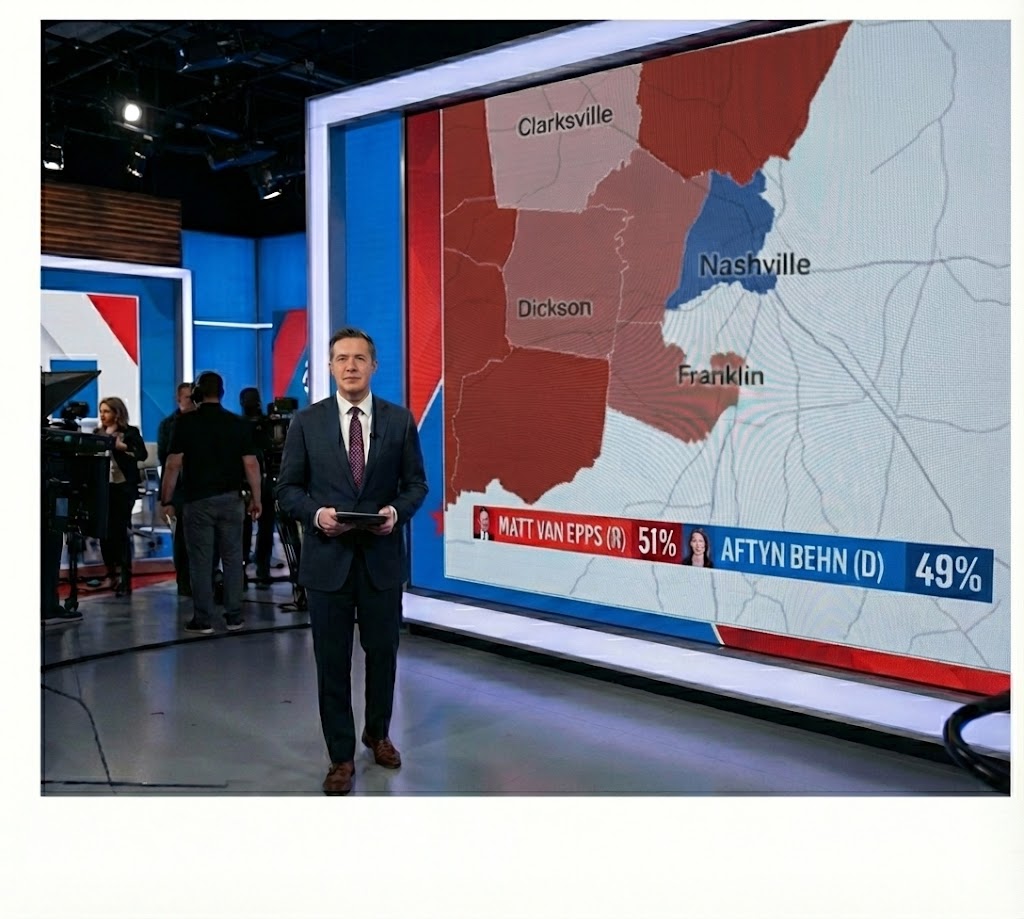
Last night’s special election in Tennessee’s 7th Congressional District ended in a Republican hold, with Matt Van Epps defeating Democrat Aftyn Behn 53.9% to 45.0%.
But the headline result masks what actually happened beneath the surface. This race delivered one of the clearest narrative warning signals of the 2025 cycle—a deep-red district that suddenly behaved like a battlefield.
Behn — a 36-year-old progressive state legislator known for her activism and unfiltered social media presence — carried the full weight of the Democratic narrative in a seat that President Trump had won by 22 points just one year earlier. That margin just narrowed to R+9, despite a full-scale national Republican intervention.
That 13-point compression did not happen by accident. It followed the exact moral, narrative, and persuasion dynamics PharosGraph identified before a single vote was cast.
This Was a Persuasion Race, Not a Base Race
Long before Election Day, PharosGraph’s models showed that TN-07 was not shaping up as a conventional turnout contest between two locked bases. It was shaping up as a persuasion environment layered on top of a rigid partisan structure.
The most important pre-election signal was asymmetry:
one candidate was optimized to hold identity voters steady; the other was optimized to move undecided and weakly attached voters.
That asymmetry appeared consistently across three PharosGraph systems:
- Hero narrative
- Moral foundations
- Issue polarity and persuasion
In practical terms, the question was never “can Democrats win this seat?”
Instead, the question was: “how much narrative-driven persuasion could shift the outcome inside a district drawn to strongly favor one party.”
Hero Narrative and the Classic Mobilization Triangle
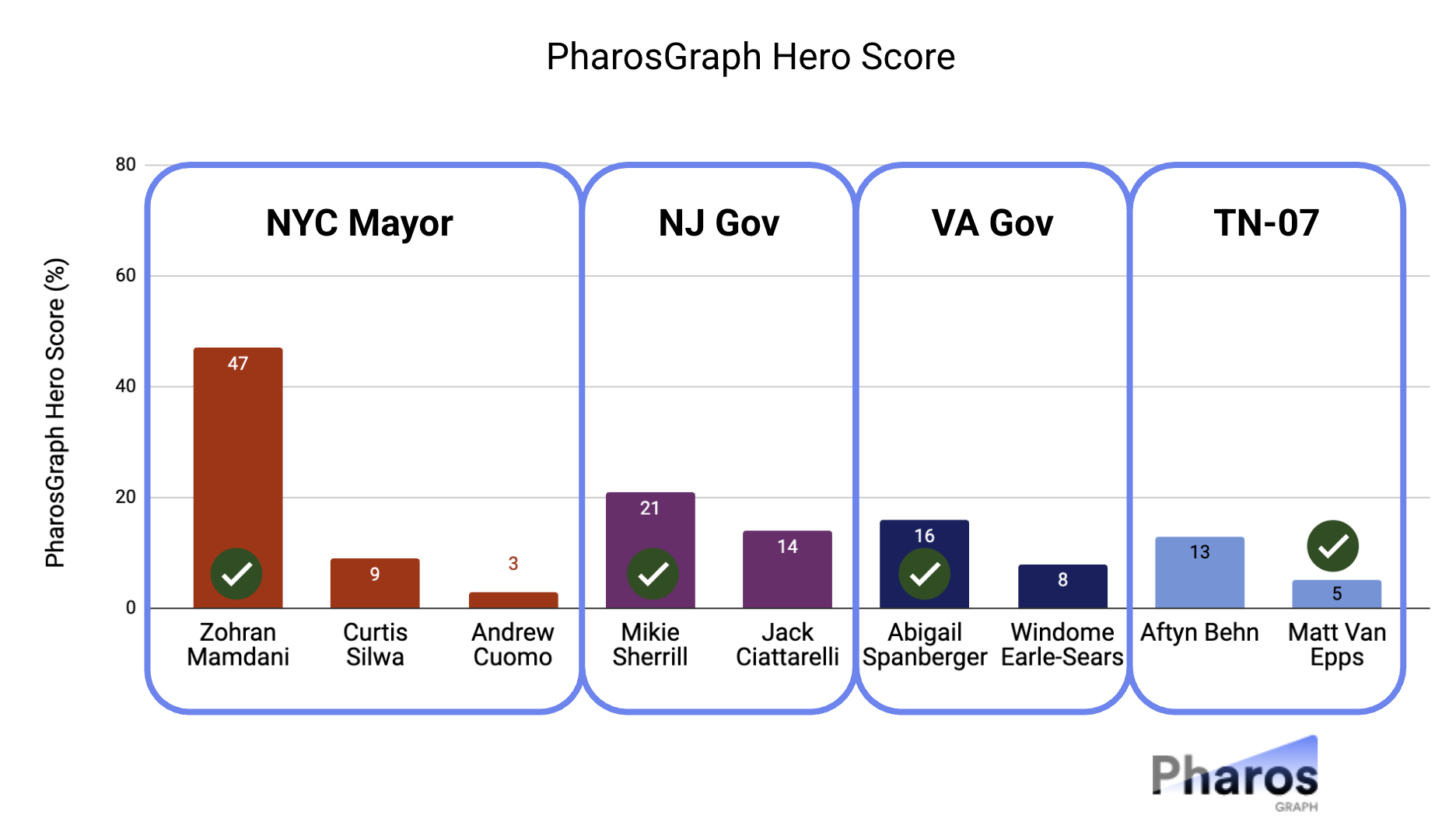
In PharosGraph’s hero model, Aftyn Behn entered the final stretch holding a 2.7× advantage in Hero Score over Matt Van Epps. In multiple 2025 races, a Hero advantage in this range has consistently marked where late momentum forms, even in districts with a strong partisan bias.
But hero advantage only becomes electorally potent when it aligns with the right moral activation pattern. In TN-07, Behn’s narrative authority mapped directly onto what PharosGraph defines as the classic mobilization triangle:
- Care: Behn was framed as the candidate most attentive to those who felt personal risk, including rising household costs, exposure to healthcare instability, and the everyday vulnerability created by economic pressure. Holding moral authority on Care positioned her as the actor responding to immediate human need rather than abstract policy debate.
- Fairness: She was framed as the candidate confronting unequal burden and systemic imbalance—who absorbs the cost of inflation, who is shielded from price shocks, and whether the economic rules are being applied evenly. This framing gave her narrative ownership over who the system is working for, and who it is leaving behind.
- Change / Subversion: Behn was framed as the candidate challenging the adequacy of the existing order itself, signaling that current leadership and policy structures are no longer sufficient to solve today’s problems. This granted her the moral permission to argue for disruption rather than preservation.

When a single candidate simultaneously holds moral authority across Care, Fairness, and Change, the narrative environment shifts toward mobilization and persuasion, not simply base retention. The election becomes a choice about who will act on lived conditions, not just who represents inherited political identity.
By contrast, Van Epps’ narrative profile leaned far more heavily into Authority and Loyalty—forces that stabilize Republican identity voting, but which are structurally weaker at pulling undecided or economically stressed voters across persuasion thresholds.
The result in TN-07 was a race where retention and persuasion were being driven by completely different moral logics at the same time—a dynamic that powered the late Behn surge and triggered the scale of the Republican counter-response.
Issue Polarity: Who Held Narrative Agency
PharosGraph’s framing-polarity system does not ask which side owns each policy. It asks something more basic: Who is being framed as an active problem-solver versus a passive position-holder?
On that dimension, Behn held a decisive positive polarity advantage on:
- Affordability and inflation
- Abortion and reproductive rights
- Crime and public safety
- Infrastructure
- Education and healthcare access
Across these domains, coverage consistently framed Behn as someone doing something about lived conditions, while Van Epps appeared more often as the representative of an existing order.
Van Epps maintained his strongest polarity footing on fiscal governance and national debt — issues that remain structurally important in conservative districts, but that carry lower emotional immediacy in a cycle dominated by household cost stress and healthcare anxiety.
The polarity data indicated that the emotional center of gravity of the election favored Behn, even as the structural center of gravity did not.
Persuasion and Clarity: Why Republicans Moved to Halt the Surge
Polarity describes the narrative weather. Persuasion describes whether voters actually move.
On PharosGraph’s persuasion and clarity models, Behn outperformed Van Epps on:
- Affordability
- Crime and public safety
- Infrastructure
- Education
- Healthcare access
Her positions on these issues were not just framed more positively — they were also clearer and more compelling to swing voters. Van Epps retained a strong persuasion edge on national debt and macro-economic governance, but those topics ranked consistently lower in 2025 issue salience than immediate cost pressure and healthcare expense.
This arrangement is the textbook structure of a late persuasion surge: one candidate becomes both more legible and more trusted on the issues voters feel most acutely.
It also explains the scale of the Republican response. Holding the seat required:
- A multi-million-dollar national rescue
- Heavy Trump-aligned super PAC investment
- A late attack sequence casting Behn as a cultural radical
From a PharosGraph perspective, that intervention tracks precisely with an effort to collapse a growing persuasion advantage by shifting cognitive shortcuts from “problem solver” back to “identity risk.”
Geographic Structure Versus Narrative Density
Structure still matters. And in this case, structure ultimately held.
Van Epps dominated across the rural and exurban counties characterized by strong identity voting, cultural conservatism, and fiscal-authority messaging. Those regions continue to provide Republicans with deep vote cushions that are difficult to dissolve through narrative alone.
Where the PharosGraph data becomes especially instructive is in how Behn’s gains are concentrated.
At the block-group level, the strongest scores clustered sharply inside:
- High-density metropolitan Nashville precincts
- Suburban and semi-urban Clarksville zones
- Several commuter-belt micro-corridors where affordability pressure is most visible
That density effect is why Behn posted:
- A greater than 50-point win in the Davidson County portion of the district
- A roughly 20-point improvement over the 2024 Democratic margin there
The result is a district that still leans red when mapped by land, but that now contains distinct, high-turnout persuasion basins where moral narrative outweighed partisan identity.
Why This Loss Is a Strategic Warning Shot
National Democrats and pundits were quick to frame the result as a 2026 warning — and the moral-narrative structure of the race supports that interpretation.
This contest demonstrated that:
- Care–Fairness–Change moral framing can now meaningfully erode structurally engineered partisan seats
- Hero narrative advantage reliably compresses margins even in hostile terrain
- Issue ownership is no longer sufficient without narrative agency
- Winning coalitions are increasingly built through moral alignment, not ideological moderation
With nearly 100 Republican-held seats nationally sitting on less pro-Trump terrain than TN-07, and Democrats needing only three flips to reclaim the House, the lesson is no longer hypothetical.
That shift is already taking shape across competitive districts.
The PharosGraph Takeaway
PharosGraph’s models did not forecast a guaranteed win. They forecast:
- A live persuasion battlefield inside a deep-red district
- A polarity and persuasion advantage on the issues voters feel most viscerally
- A late Republican counter-mobilization aimed at collapsing that advantage
- And a nationally meaningful compression of partisan margins
Every one of those dynamics materialized.
TN-07 did not flip. But it redefined where narrative power now begins to overpower partisan structure.
The real contest is no longer left versus right. It is stable identity versus narrative agency — and agency is now gaining ground.


The Suburban Bloc That Could Swing the 2026 Texas Senate Race

What Local TV Ad Sales Teams Are Missing in Political