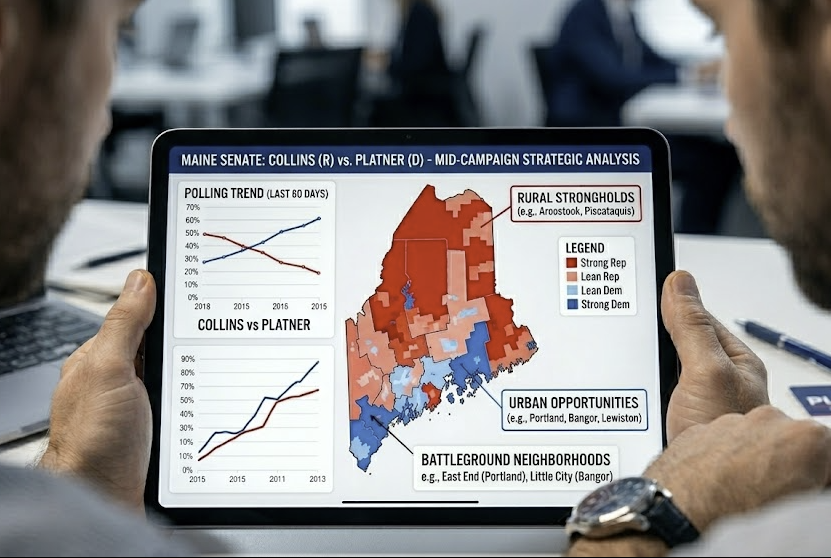
The Illusion of Rational Politics

How Stories, Emotions and Moral Judgment Shape Elections
Voters begin interpreting political events long before they form explicit opinions about them. My work at the intersection of narrative framing and moral psychology shows that these interpretations form fast, often before campaigns even recognize an issue as significant. The real contest in modern politics is not over information. It is over meaning, and meaning follows a set of patterns that are far more predictable than most campaigns realize.
It is an elegant model and a comforting one. It treats politics like a competition of reason. But it is also fiction. Most real voters don’t make decisions this way, not because they are irrational, but because they are human. They navigate politics with limited information, limited attention and limited patience for complexity. They make sense of events through stories. They react to what feels morally right or wrong. They draw on emotional signals and social cues. They remember what matches their identity and values. They forget the rest.
The evidence for this is overwhelming. Research in moral, cognitive, and social psychology, neuroscience, behavioral economics, communication, and evolutionary biology all point to the same conclusion. People construct their judgments as they go. They do not retrieve fully formed opinions. They assemble them using the ideas and emotions that are most accessible in the moment. When the context changes, the judgment changes. When the emotional climate shifts, the meaning of the issue shifts with it.
Accepting this reality changes everything about how campaigns understand public opinion. Elections are not settled by the best platform. They are shaped by the stories people tell themselves about what is happening and who is responsible. They are driven by the moral meaning attached to events. And that meaning can shift quickly when emotions rise.
PharosGraph was built to understand that meaning. Not by predicting how people should behave, but by observing how people actually think. To understand why this matters, we have to start by letting go of the illusion of rational politics, at least to a significant extent.
Why the brain defaults to stories
Human beings are storytelling creatures because the mind needs simple moral structures to interpret complexity. The same basic pattern appears everywhere in human storytelling from ancient epics like Gilgamesh and The Iliad to modern political narratives. These narratives follow simple patterns. Someone is harmed. Someone is responsible. Someone can help. Victim, villain and hero.
These roles are not storytelling techniques invented by speechwriters. They come from how the brain organizes moral information. Moral psychologists like Jonathan Haidt have shown that we react to harm, fairness, loyalty, authority and purity through immediate intuition rather than conscious reasoning. Joshua Greene describes moral thinking as a fast emotional reaction that is later justified with slower logic. Frans de Waal’s work on primates shows that social animals evolved rules and expectations long before they evolved language.
When applied to politics these patterns run instantly. A complicated policy debate or unfolding crisis appears and the mind races to locate who is suffering, who caused it and who can fix it. If that frame locks into place early it becomes difficult to dislodge. Facts get interpreted through the story rather than the other way around. Candidates who fail to understand which roles voters have assigned to each actor will struggle to change the narrative no matter how sound their policy arguments are.
PharosGraph focuses on this early interpretive layer, where the emotional and moral shape of an issue is set long before they become visible in traditional metrics. By the time a campaign sees a shift in polling, the public meaning is already set. Narrative intelligence helps detect these shifts in their early formation, when the stakes are still low and the emotional climate is still fluid.
How media turns complexity into moral drama
Even if voters wanted to approach politics through detailed analysis, the structure of modern media would push them in a different direction. The business model of news relies on reach, engagement and retention, all of which reward simplification. Complex stories shrink into familiar moral shapes because those shapes attract larger audiences. As an issue gains attention, coverage follows a predictable arc. It begins with technical description, but once the stakes touch moral values or perceived risk the tone shifts. Narratives simplify. Emotional language crowds out detail. The story becomes one of victims and villains because that is what keeps people watching.
Communication research shows why this happens. When an issue becomes salient, people demand clarity. News organizations respond because emotional stories capture attention. And attention is the scarce commodity of modern media. This shift is not a sign that reporters have become less serious. It reflects how audiences process information under pressure. Complex problems are squeezed into familiar moral shapes because that is what the mind can hold.
This is why campaigns must recognize when an issue is on the verge of gaining emotional traction. Once a story becomes moralized the public interprets everything else through that frame. A candidate who speaks in technical language during a moral moment appears indifferent. A candidate who responds with narrative clarity gains trust.
PharosGraph tracks the emotional temperature of coverage because it signals when events are moving from descriptive to moral. That transition is where political opportunity is created or lost.
Fear, outrage and the engines of political behavior
Two emotions consistently drive political action. Fear and outrage.
Fear operates through perceived risk, shaped by heuristics that evolved to keep our ancestors alive. Research by Paul Slovic and others shows that people react most strongly to threats that feel new, unfamiliar, uncontrollable or potentially catastrophic, which is why issues like immigration, emerging technologies and public health crises often generate outsized fear compared to their objective risks. These reactions are not calculations. They are fast, automatic judgments driven by uncertainty, perceived lack of control and the sense that consequences could spiral beyond human management. When fear rises, people look for protection and gravitate toward leaders who project order and authority.
Outrage arises when people believe a moral norm has been violated. It spreads quickly because it signals group membership. Outrage is a form of moral communication. It marks who is inside the circle of concern and who is outside. Haidt’s work makes clear that different groups respond to different kinds of violations. Liberals react strongly to harm and unfairness. Conservatives also care about harm and unfairness, but they have a wider palette than liberals paying relatively equal attention to loyalty, authority and sanctity. Libertarians react intensely to violations of individual freedom.
These emotional drivers explain why some issues ignite overnight. They also explain why campaigns cannot rely on neutral messaging during emotional moments. Fear requires a language of safety. Outrage requires a language of accountability. Hope opens the door to persuasion. Understanding which emotion dominates an issue is essential for understanding how voters will respond.
Why the same issue means different things to different groups
People do not interpret events in the same way because they do not share the same moral filters. Moral foundations theory has demonstrated that political groups prioritize different moral values. This is not a matter of education or intelligence. It is a matter of identity. The same event can appear as a moral crisis to one group and a nonissue to another.
A story framed around harm resonates strongly with liberals. A story framed around community or tradition resonates strongly with conservatives. A story framed around freedom resonates strongly with libertarians. These reactions are predictable and deeply rooted. They explain why attempts at persuasion often fail. Not because people are closed minded, but because the message conflicts with their core values.
Understanding these differences is critical for political communication. It allows campaigns to speak in a language that feels authentic to each audience. PharosGraph’s value analysis identifies which moral foundations are active within each segment so campaigns can communicate without triggering resistance.
Value congruence and the stickiness of political narratives
Once a narrative aligns with a person’s values it becomes difficult to replace. People resist information that threatens their identity because accepting it would require changing how they see themselves. This process, known as motivated reasoning, has been documented across disciplines. People accept value-consistent information quickly. They interrogate value-inconsistent information heavily. They are not searching for truth. They are searching for coherence.
This helps explain why factual corrections often fail. When a correction clashes with a person’s moral worldview it feels wrong even if it is accurate. When a narrative aligns with that worldview it spreads because it feels intuitively right. Campaigns that understand value congruence can anticipate which stories will hold and which will collapse under their own weight.
The battle between competing frames
Political issues rarely carry a single meaning. They come with competing frames that emphasize different causes, victims and responsible actors. Some frames highlight individual responsibility. Others highlight systemic failure. Some emphasize fairness. Others emphasize security. These frames battle for dominance in the public mind.
When two frames compete, people choose the one that best fits their values and emotional expectations. Conflicting frames can cancel each other. When responsibility is ambiguous, people default to the interpretation that feels morally resonant. This is why political debates often feel like parallel conversations. People are not evaluating the same story. They are evaluating different interpretations of the same facts.
Frames that repeat become more accessible. Frames that appear recently rise to the top of memory. Frames delivered by trusted voices carry more weight. This competition determines the public meaning of events. The facts do not decide which frame wins. The emotional and moral context does.
PharosGraph monitors frame dynamics as they shift. It clarifies which interpretations carry increasing weight and which are slipping from focus in the narrative environment.
Why political actors are judged more harshly than the public
Another consistent finding in research on moral judgment is the asymmetry between powerful actors and those affected by their actions. People generally assume that leaders have greater control and therefore greater responsibility. They grant ordinary citizens more benefit of the doubt and more room for error, while holding elites to stricter moral standards. Populist leaders can become partial exceptions when they successfully frame themselves as targets of larger forces rather than agents of them. In those cases, responsibility is psychologically redistributed and accusations of wrongdoing are more easily interpreted as persecution rather than proof of intent.
This asymmetry means that political actors cannot count on the presumption of innocence once a negative narrative forms. The public expects warmth as well as competence. A leader who appears cold or evasive is quickly cast as a villain. A leader who appears concerned and accountable gains trust. These judgments happen fast and they stick.
Research on reputation and public meaning, including work by Daniel Diermeier, shows that once audiences infer negative intent they reinterpret even neutral actions through that lens. A slow response appears evasive. A delayed explanation appears calculated. This is why narrative clarity and empathetic signaling matter as much as policy detail during moments of uncertainty.
How trust collapses and how it is repaired
Trust is one of the most fragile assets in politics because it rests on assumptions about intent. When those assumptions break, trust can collapse quickly, but not always universally. Supporters often extend what can be thought of as a home-team effect, giving their own leaders far more benefit of the doubt than they would grant opponents. In those cases, the collapse of trust is rarely triggered by the facts alone. It is driven by whether a leader is seen as indifferent to harm, unwilling to take responsibility or acting against the values of their own coalition. Trust fractures first across group boundaries and only later, sometimes much later, within them.
How leaders respond in the first moments after trust is shaken often matters as much as what actually happened. For political leaders, the relationship between response and trust is shaped by the constant churn of media attention. Because prominent politicians operate in an always-on news environment, silence can sometimes function as a strategic pause rather than a signal of bad intent, allowing outrage to dissipate as the news cycle moves on. This does not mean silence is always safe or effective. It depends on how intense the initial reaction is, how emotionally charged the issue becomes and whether the leader’s core supporters remain psychologically anchored. For lesser-known politicians or those outside constant national attention, early interpretation hardens much faster and delayed response carries far greater risk. In those situations, the dynamics begin to resemble what we see in high-attention crises for organizations, where early meaning can become fixed before any later correction lands.
Effective trust repair therefore requires clarity, empathy and commitment. It requires leaders to speak early, acknowledge concerns and make visible changes. It requires sensitivity to cultural expectations of apology and authority. What restores trust in one community may fall flat in another.
This is not crisis management. It is moral communication. It shapes whether the public views a leader as part of the solution or part of the problem.
Why political meaning is created before it is measured
By the time a shift appears in polling, the public has already made sense of an event. Meaning forms early in low-attention environments where stories, values and emotions guide interpretation, and once it sets people begin to explain their views as if they arrived at them through deliberate reasoning. This post-hoc rationalization makes early judgments feel stable and considered even when they were formed quickly. It also explains why campaigns so often feel blindsided. They are measuring the end state of a process that began long before they noticed it.
Narrative intelligence is designed to detect these early signals. It examines how issues are framed in media and conversation, how emotional temperature is rising or falling and how audiences are assigning moral roles. This approach does not compete with polling. It explains the context in which polling results make sense. It reveals the hidden scaffolding beneath political behavior.
PharosGraph was built on this insight. It maps the structure of public meaning as it develops so campaigns are not trapped reacting to yesterday’s narrative. It provides a way to see how people are interpreting an issue before those interpretations harden.
The real work of modern campaigns
The illusion of rational politics is persistent because it is comfortable. It allows campaigns to believe that better ideas will win on their merits. But voters are not evaluating policy white papers. They are navigating a moral landscape. They are reacting to stories that help them explain a complicated world. They are responding to threats, hopes and violations of values.
Modern campaigns must understand the forces that shape that landscape. They must anticipate the emotional turn in coverage. They must understand the moral filters through which different audiences see the world. They must pay attention to value congruence and frame competition. They must communicate in ways that build and maintain trust. And they must do it early, before the meaning of an issue is set.
Some might see elements of manipulation here, but at its core this is about aligning communication with how people naturally make sense of the world. Voters seek coherence, safety and moral clarity, and campaigns that respect those needs are better equipped to engage them honestly.
Political meaning forms before it is ever measured. People organize events into stories of harm, blame and responsibility, assigning heroes, villains and victims almost instantly. By the time opinion is recorded, that story is already doing the work. The task of a campaign is not to overwrite that structure but to understand it early enough to engage it wisely.


The Suburban Bloc That Could Swing the 2026 Texas Senate Race
What Local TV Ad Sales Teams Are Missing in Political