California Governor's Race: Only One Democrat Is Gaining Everywhere
Ten days after Swalwell's exit, PharosGraph data shows only one candidate building support across every dimension of his fractured coalition.
Ten days ago, Eric Swalwell dropped out of the California governor's race and we published an analysis of where his voters would go. Our conclusion: they wouldn't go anywhere together. Swalwell's coalition was built on anti-Trump resistance, not shared policy priorities, and it would fracture along different lines depending on what each voter segment cared about most.
That's exactly what happened. But the fracture has created a bigger problem.
There are 61 candidates on the June 2 ballot, 24 of them Democrats. But only six Democrats are polling above 1%, and they're splitting the vote while two Republicans consolidate theirs. California's top-two primary sends only two candidates to the general election regardless of party. If Democrats keep dividing and Republicans don't, November could feature two Republicans on the ballot and no Democrat. Five weeks out, that's not a hypothetical.
So the question has shifted. It's no longer "where do Swalwell's voters go?" It's "who can assemble a coalition broad enough to finish in the top two?"
$100 Million and a One-Point Lead
Tom Steyer has spent over $100 million on advertising. That's more than every other candidate in the race combined, accounting for 76% of all ad spending in the primary. He picked up the California Teachers Association endorsement after Swalwell left. Our Revolution, the organization founded by Bernie Sanders' movement, endorsed him last week, the first time they've ever backed a billionaire.
And after all of that, Steyer leads Xavier Becerra by exactly one point among Democratic voters (20% to 19%) in the latest Emerson poll.
Katie Porter is at 15%. Despite running without corporate PAC money, she holds the strongest organic voter preference among Swalwell's former supporters. In second-choice polling, she consistently leads.
PharosGraph measures how every candidate's profile resonates with voters in each of California's 23,000+ neighborhoods. We look at where candidates stand on issues, who they connect with demographically, how they frame their message, and what moral values they emphasize. When we map Steyer and Porter against those neighborhoods, they light up the same areas. They share 46 out of 57 voter segments. Young, diverse, lower-income, rent-burdened communities. Progressive on healthcare and climate. Motivated by fairness and protecting the vulnerable.
That overlap is the story of the progressive lane. Two candidates competing for the same voters, one with $100 million in airtime and the other with deeper organic affinity. Neither can consolidate the lane while the other is in it. The longer both stay in, the more likely a Republican finishes ahead of at least one of them.
Becerra Is Building Something Different
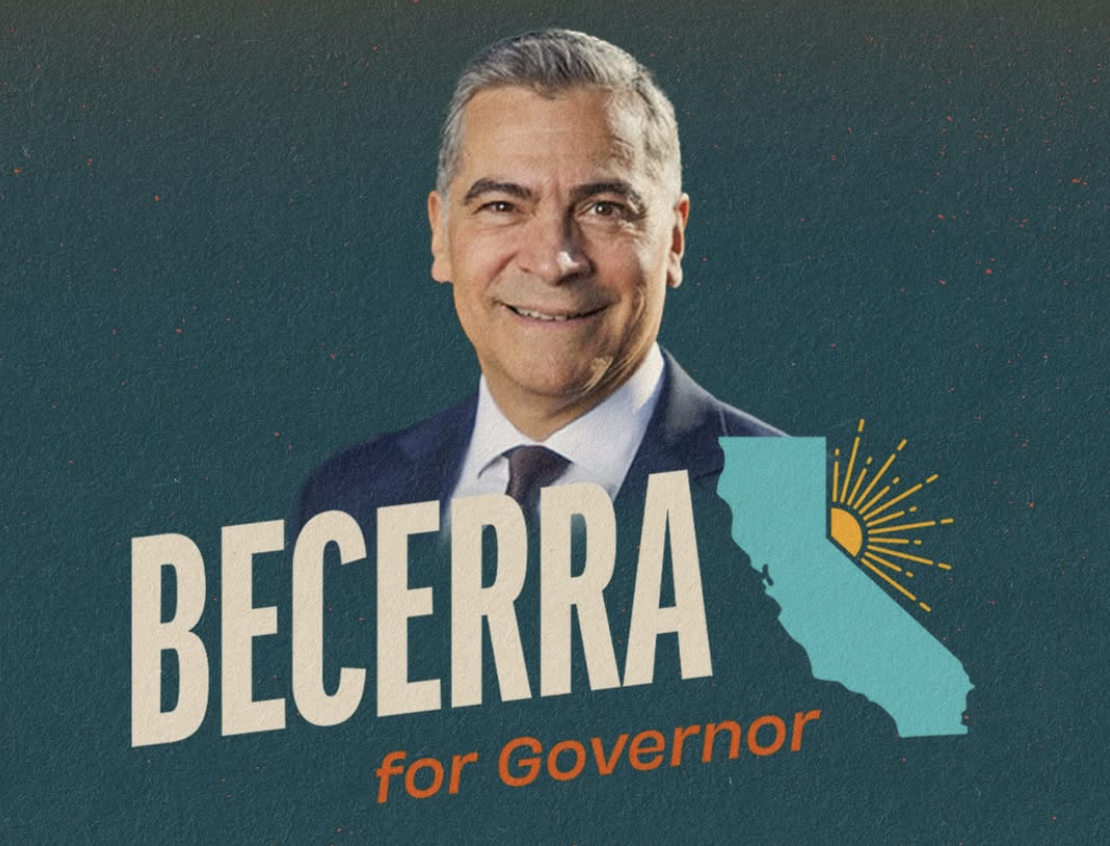
Xavier Becerra isn't winning on any single dimension. He doesn't have Steyer's money or Porter's second-choice preference. What he has is something neither of them does: he's gaining ground everywhere at once.
PharosGraph scores every candidate across 19 demographic dimensions (income, education, age, race, homeownership, employment, voter turnout, and more), then maps those scores to actual neighborhoods across the state. When we look at which voter groups show positive affinity for both Swalwell and each remaining candidate, the movement over the past week is striking.
A week ago, Becerra overlapped with Swalwell's voter base in 21 out of 57 demographic groups. In our latest data, that number jumped to 32. In ten days, he gained ground with low-income neighborhoods, moderate-education communities, mixed urban and suburban areas, moderate-turnout voters, and working families. These aren't deep-blue progressive strongholds or affluent suburbs. They're the middle of the California Democratic electorate, the working and middle-class communities where primaries are decided.
Porter reaches a similar breadth (33 groups), but her overlap is concentrated in the progressive base she already shares with Steyer. Becerra is picking up the segments that the progressive lane isn't reaching.
On issue positions, the picture is even clearer. When we measure which active candidate's stances most closely match Swalwell's across the full range of topics California voters care about, cost of living, healthcare, housing, public safety, immigration, climate, Becerra leads the field. His positioning is closer to where Swalwell stood than any remaining Democrat.
And voters are responding. In the first Emerson survey after Swalwell's exit, Becerra jumped from 3% to 10% overall and from 4% to 19% among Democrats, the largest single-candidate gain in the poll. On Polymarket, he's overtaken Steyer entirely, trading at 43% to win the general election versus Steyer's 34%.
Becerra is the only candidate whose coalition is growing across multiple dimensions simultaneously: issue alignment, demographic breadth, and the combination of Latino identity and progressive resistance credentials that no other remaining candidate offers together.
Two Lanes, Both Crowded
Most coverage of this race focuses on the progressive lane. But it's not the only lane that's splitting votes.
When we map the voter segments where Becerra and Matt Mahan both show positive affinity, they share 36 out of 57 groups. Becerra and Mahan are competing for many of the same voters, just as Steyer and Porter are on the progressive side. The difference is that Mahan is polling at 5% and has a fraction of Becerra's momentum.
Becerra's structural advantage is that he sits between the lanes. He pulls from moderate, working-class, middle-income communities that Steyer and Porter don't reach, while also resonating in progressive-leaning neighborhoods where Mahan doesn't register. No other candidate in the field has that kind of range.
Antonio Villarigosa has strong name recognition in Southern California, but his appeal is narrow. He connects with just 17 out of 57 voter groups. Where he's strong, he's strong. But he doesn't have the breadth to build a statewide coalition.
The Top-Two Danger
The fear of two Republicans on the November ballot is justified.
The latest Emerson poll has Steve Hilton at 17% and Chad Bianco at 14%. Both Republicans are already in the top four. Six Democrats polling above 1% are splitting the remaining vote, with 23% of voters still undecided.
At the state GOP convention this month, Bianco took 49% of delegate votes and Hilton took 44%. Neither hit the 60% threshold for a party endorsement. Trump backed Hilton, but it wasn't enough to unify the party. Two Republicans splitting their side helps Democrats, but only if Democrats can get at least one candidate into the top two.
The path for Democrats requires either the progressive lane consolidating behind one candidate, or a candidate who draws from across the Democratic electorate rather than from one lane within it. A candidate who isn't splitting votes with two or three others pulling from the same communities.
That's the path Becerra is on. His support doesn't come from one ideological lane. It comes from being the most balanced candidate across every dimension we measure.
The Field Is Shrinking. Is It Shrinking Fast Enough?
Five Democrats have now withdrawn from the race since campaigning began. Betty Yee suspended just this week, becoming the latest to exit a field that the Democratic Party chair has been publicly urging to consolidate. Endorsements from organizations like Our Revolution are explicitly framed around strategic necessity, not ideological preference. The party sees the math.
But six Democrats polling above 1% remain, and the June 2 primary is five weeks away. The next month will be shaped by two questions. First: does the progressive lane consolidate, or do Steyer and Porter keep splitting it? Second: can Becerra's multi-dimensional momentum translate into enough raw vote share to finish in the top two?
The data suggests his path is real. Whether the voters, the endorsements, and the remaining campaigns see it in time is a different question.
PharosGraph is tracking this race weekly across every dimension that shapes how voters decide. Our original analysis of Swalwell's fractured coalition is here.
Want to see the full picture? We're offering a complimentary California Governor's Race Brief to campaigns, PACs, and media buyers who want to go deeper. The brief includes candidate position alignment mapped against voter priorities, narrative framing analysis, audience strengths by demographic segment, and an activation plan identifying the specific neighborhoods where your message will have the most impact. Contact info@pharosgraph.com to request yours.
PharosGraph analyzed the California governor's race across 23,000+ neighborhoods statewide, 20+ issues, and the full active candidate field using our multi-dimensional election intelligence model. Data is refreshed weekly. For race-level analysis and voter targeting data, visit pharosgraph.com.
Sources: Emerson College Polling, Polymarket, CalMatters, The Intercept, LA Mag.


The Suburban Bloc That Could Swing the 2026 Texas Senate Race

What Local TV Ad Sales Teams Are Missing in Political