Where Do Swalwell's Voters Go Now?
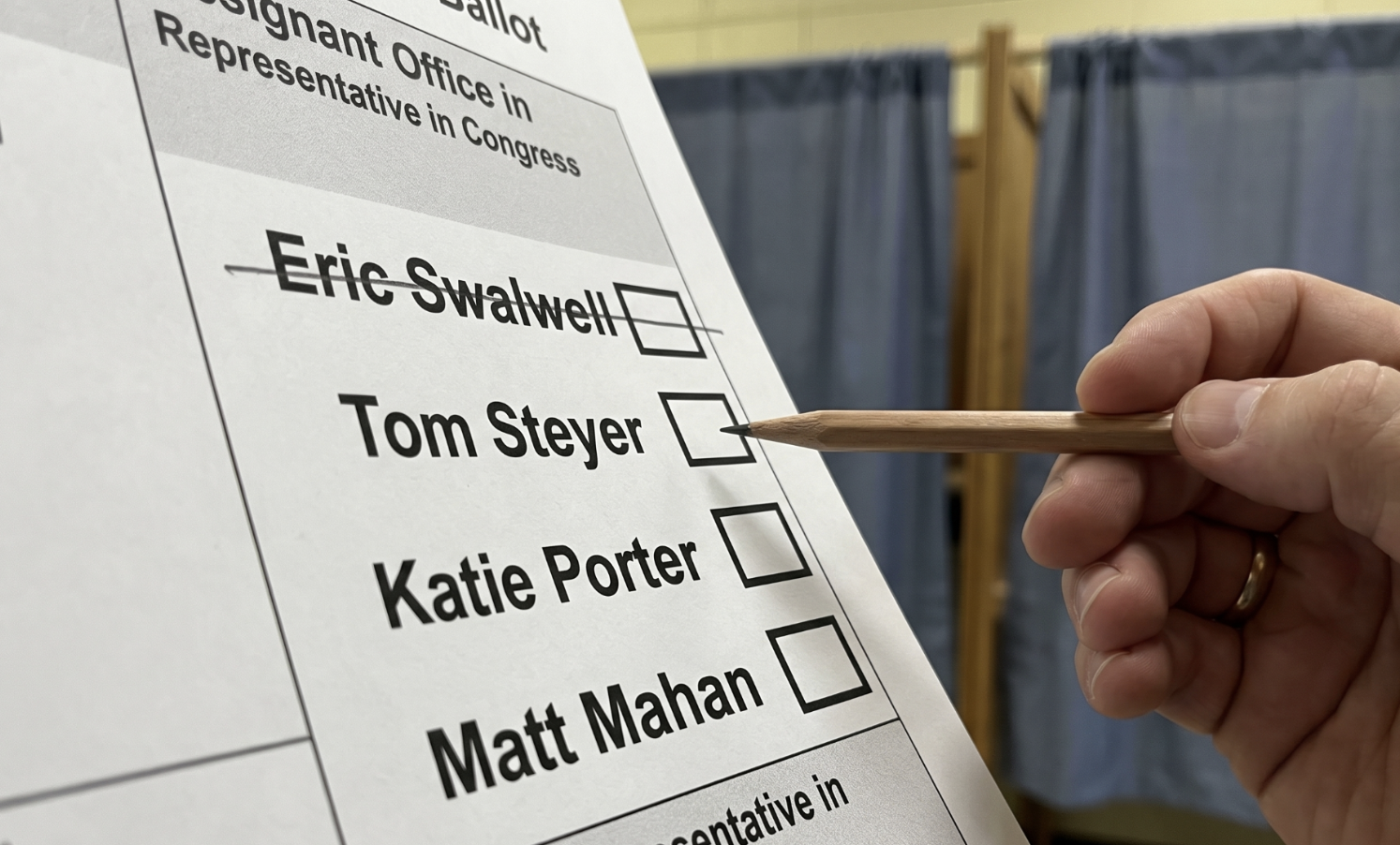
Polls, endorsements, and donor money point at three different candidates. PharosGraph's data shows which ones have the clearest path to Swalwell's voters, and why.
When Eric Swalwell suspended his campaign for California governor on April 13, he left behind roughly 17% of Democratic primary voters looking for a new candidate. The June 2 top-two primary is seven weeks away, and it will determine whether Democrats even make the general election ballot.
Within 72 hours, the political world offered three confident answers to the question everyone was asking: Where do Swalwell's voters go?
The endorsement tracker said Tom Steyer. Multiple state legislators who had backed Swalwell flipped to Steyer within days. Rep. Ro Khanna began appearing in his television ads. The institutional Democratic machinery was choosing sides.
Second-choice polling said Katie Porter. A UC Berkeley/Politico survey found 39% of Swalwell voters named Porter as their next choice, compared to 15% for Steyer.
Donor flow said Matt Mahan. Within a week, $10 million poured into the "Back to Basics" PAC supporting Mahan's campaign, with contributions from Rick Caruso, Reed Hastings, and Michael Moritz. Silicon Valley and Los Angeles money was making its bet.
Prediction markets, meanwhile, went all-in on Steyer. He surged from 6% to 59% on Polymarket, fueled in part by $120 million in self-funded campaign spending and over a million ad airings.
Three signals. Three candidates. The political class picked whichever signal confirmed their priors and moved on. But the signals are diverging for a reason. The campaigns, PACs, and media buyers who understand that reason will have a material advantage over the next seven weeks.
A Resistance Coalition, Not a Policy Coalition
The assumption behind "where do his voters go?" is that they go somewhere together. They don't, because Swalwell's coalition was never held together by ideology in the first place.
PharosGraph analyzed this race across more than 20 issues, 19 demographic dimensions, and 10 moral foundation scores for every candidate. Swalwell's profile is distinctive: while candidates like Porter and Steyer built their brands around specific progressive policy agendas like single-payer healthcare, climate action, and progressive taxation, Swalwell's brand was built on anti-Trump resistance, prosecutorial combativeness, and defending democratic norms. On those dimensions, he scored among the highest in the field.
Where he stood apart from the rest of the Democratic field was on economic specificity. On the issues California voters rank highest (cost of living, housing, public safety, the state budget) Swalwell's public positioning was dominated by broad principles rather than the detailed proposals that characterized candidates like Porter, Steyer, or Mahan. Compared to the field, his messaging leaned heavily on who he'd fight against rather than what he'd build. That's a powerful coalition-builder in a national moment defined by Trump. It's a fragile one when the candidate disappears and voters have to choose based on policy.
A coalition held together by opposition to a threat rather than affirmative policy fractures along whatever fault lines are most salient to each voter segment. And that's exactly what the data shows:
Demographic affinity pulls toward Ian Calderon. Swalwell's strongest voter affinity was in Latino, urban, working-class neighborhoods where his housing affordability messaging and "protector" brand resonated despite his own background in affluent suburban Dublin. Calderon, a Latino state legislator from Whittier who grew up in the San Gabriel Valley, is a native of those same communities. His voter base overlaps Swalwell's by over 60% more than any other candidate in the field. For voters in those neighborhoods, Calderon doesn't just share the message. He shares the lived experience.
Thematic resonance pulls toward Porter. The "fighter" energy, the consumer-protection framing, the willingness to go after powerful interests. That's the slice of Swalwell's base that was drawn to his combativeness rather than his demographics. Porter is the most prominent resistance figure remaining in the field.
Institutional gravity pulls toward Steyer. Endorsements from elected officials, labor infrastructure, and organizational relationships migrate to the candidate who is actively courting them, and Steyer has the resources to do exactly that at scale.
Three fragments of one coalition, each responding to a different signal. This is why polls, endorsements, and donor flow are all pointing in different directions. Each is measuring a real phenomenon. None is measuring the whole picture.
And then there's Becerra, the former Attorney General and Biden's HHS Secretary, who doesn't fit cleanly into any one of these three lanes.
The Candidate Who Bridges the Split: Becerra
Xavier Becerra has the closest issue-position alignment to Swalwell of any candidate in the field. He also carries strong demographic affinity with Latino and Black communities where Swalwell had real voter resonance. And as a former California Attorney General and Biden's Secretary of Health and Human Services, he has institutional credibility that doesn't depend on spending $120 million to manufacture it.
No other candidate in the race spans all three dimensions of Swalwell's appeal the way Becerra does. Calderon has the demographics but not the institutional weight. Porter has the thematic energy but not the demographic overlap. Steyer has the institutional momentum but is buying it rather than inheriting it. Becerra is the most balanced candidate across every dimension we measure, even if he doesn't lead on any single one.
The early polling data supports this. In the first Emerson poll conducted after Swalwell's exit, Becerra surged from 3% to 10% overall and from 4% to 19% among Democratic voters, the largest movement of any candidate in the field. Voters appear to be reaching the same conclusion the data does: when you look across all the dimensions at once, Becerra is a natural landing spot for a coalition that was never built on one dimension to begin with.
The Collision That Matters Most: Steyer vs. Porter
The most consequential dynamic in this race isn't Swalwell's departure. It's what happens between the two candidates competing for the progressive lane, and the uncomfortable math of a top-two primary.
PharosGraph scores every candidate's voter affinity across 19 socio-demographic dimensions. On those dimensions, Steyer and Porter are near-identical. Both draw their strongest support from the same neighborhoods: young, lower-income, urban, diverse, rent-burdened communities. Their issue positioning is similarly aligned, with both scoring heavily progressive on healthcare, climate, and cost of living.
The difference is resources and speed. Steyer has $120 million in self-funding and the endorsement momentum from the Swalwell collapse. Porter is running without corporate PAC money, relying on the organic second-choice preference that polling shows she holds.
If Steyer's ad spending and endorsement machine convert institutional support into actual voter share before Porter can consolidate organic preference, she gets squeezed. Not because voters prefer him, but because he arrived first with more volume. Tony Thurmond, the State Superintendent with the strongest support in Black communities, is the third candidate drawing from the same voter base. Three candidates, one coalition. The math is unforgiving.
And hanging over all of it: California's top-two primary means every candidate, regardless of party, appears on one ballot on June 2, and only the top two advance. With Democrats splitting votes among eight or more candidates and Republicans potentially consolidating behind Trump-endorsed Steve Hilton, the nightmare scenario for Democrats is real: two Republicans in the general election, Democrats locked out entirely. The progressive lane eating itself makes that outcome more likely, not less.
Same Positions, Different Voters: The Mahan Puzzle
While the progressive candidates compete for the same voters, a different question is emerging in the center of the field, one that reveals something important about how political coalitions actually form.
Mahan has one of the closest issue-position alignments to Swalwell in the field. On healthcare, public safety, and cost of living, the issues Californians rank highest, they land in nearly the same place. By the conventional logic of political analysis, that should make Mahan the natural successor. But his strongest support comes from affluent, suburban, high-homeownership neighborhoods, while Swalwell's base was concentrated in urban, diverse, rent-burdened communities.
How can two candidates agree on policy and attract completely different voters? Because what you believe and how you talk about it are different things. Mahan frames healthcare through innovation and efficiency, a language that resonates with educated, tech-adjacent suburban voters. Swalwell framed the same issues through protection and resistance, defending vulnerable people against powerful interests. That moral language connected with urban communities under economic pressure. Same policy direction, different framing, different audience.
This is precisely why issue-position analysis alone misreads voter behavior. PharosGraph scores every candidate across all of these dimensions (issue positions, demographic affinity, moral foundations, and media framing) then resolves the results to each of California's 23,000+ census block groups. That granularity is what makes it possible to see not just that two candidates share policy positions, but that those positions land differently in Cupertino than they do in Compton.
It also reveals Mahan's opening. He holds two clear lanes on issues where the progressive candidates barely register. On healthcare, he leads the field with an innovation-focused approach that most other Democrats haven't staked out. On public safety, he takes a pragmatic position that leads the field while the progressive candidates cluster around civil-rights-first framing that plays well in San Francisco and West Los Angeles but poorly in the Central Valley and suburban Sacramento. And there are specific voter segments (educated, urban, middle-income, high-turnout communities) where both Mahan and Swalwell carry positive affinity. Those are the persuadable voters, and they're reachable with the right message on the right issues.
The $10 million flooding into Mahan's PAC suggests the donor class sees the same opening. Whether it converts depends on whether his campaign can reach those voters before the progressive lane consolidates and the race narrows.
What This Tells Us About the Race
The June 2 primary is not waiting for anyone to figure this out. The first post-exit poll already shows the coalition fragmenting across multiple candidates, with no single successor capturing a majority of Swalwell's support. Every week of inaction is a week where those voters anchor to someone else.
The campaigns that move first with the right message in the right neighborhoods will capture a disproportionate share.
PharosGraph built this analysis using the same methodology we apply to every committed race: 23,000+ neighborhoods scored across every dimension that shapes how voters actually decide. We put together a sample brief showing two paths through this exact race, one for a pragmatist candidate with open issue lanes, one for a progressive candidate navigating a crowded field. Same data, different strategies.
Email info@pharosgraph.com for free access to the brief.


The Suburban Bloc That Could Swing the 2026 Texas Senate Race

What Local TV Ad Sales Teams Are Missing in Political