
Maine Senate General Election Preview: Collins vs. Platner
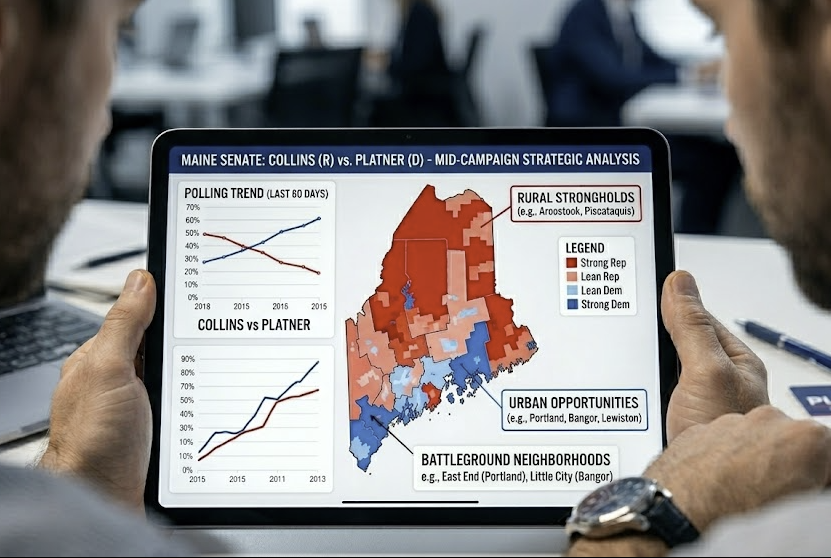
The New Landscape
Governor Janet Mills' suspension of her Senate campaign on April 30 reshapes the Maine Senate race from a crowded Democratic primary into a clear two-way contest. Graham Platner, a harbormaster and oyster farmer from the Midcoast, will face five-term incumbent Susan Collins in November. The matchup pits one of the Senate's most durable moderate brands against a populist challenger whose rise has been as turbulent as it has been rapid.
This brief draws on PharosGraph's weekly RaceScape data to assess both candidates' positioning across the issues that matter most to Maine voters. To request a free copy of the full brief, email: info@pharosgraph.com
What Maine Voters Care About
PharosGraph's issue radar tracks 20+ issues for this race and ranks them by salience each week. The top issues this week:
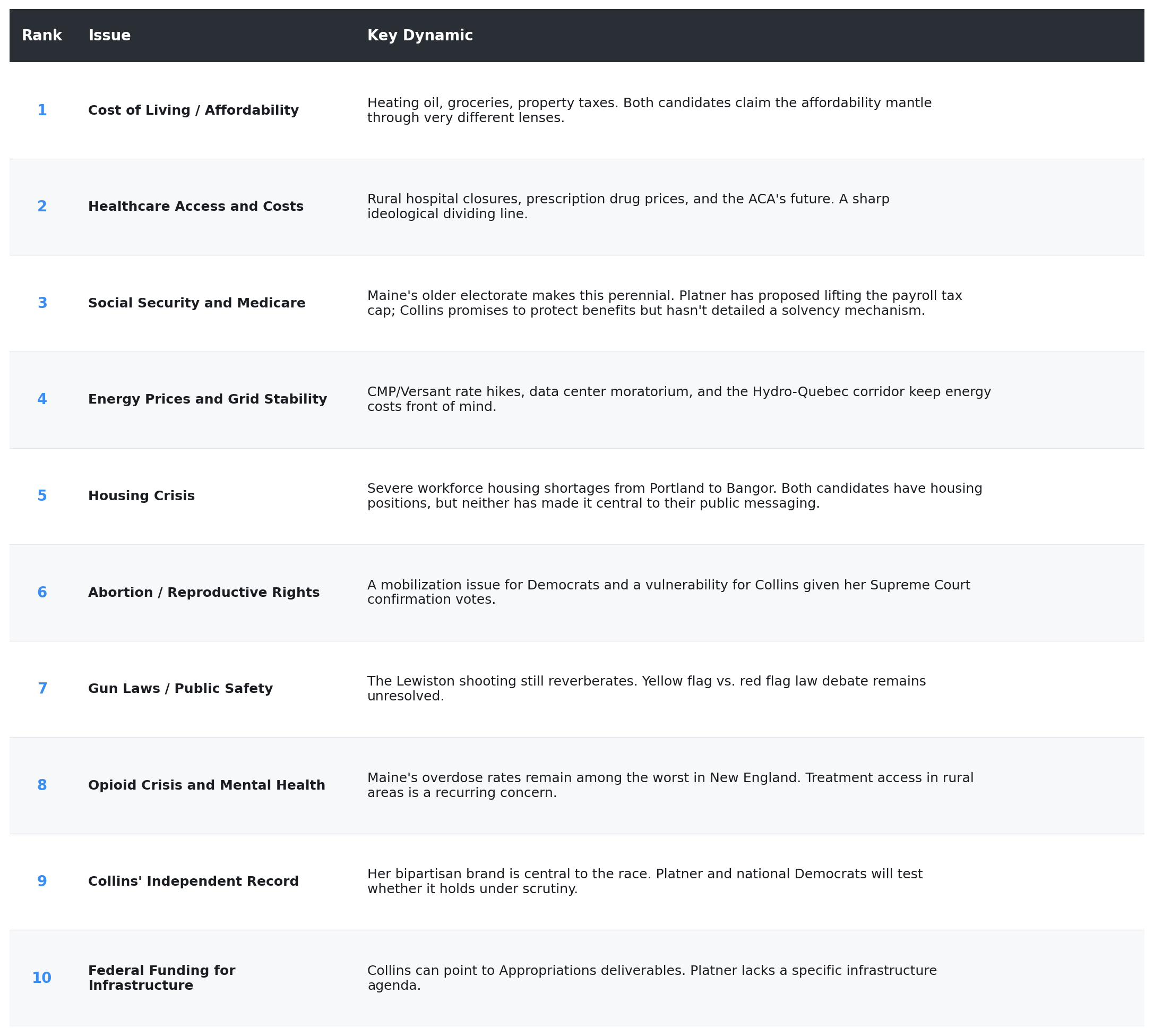
Lobster fishing regulations and PFAS contamination round out the top 12.
Susan Collins: The Incumbent's Profile
Archetype: Pragmatist / Guardian
Core brand: Bipartisan problem-solver. Collins has built a career on crossing the aisle, chairing the Appropriations Committee, and delivering tangible results for Maine. Her top themes center on prescription drug affordability, Social Security protection, rural economic support, and judicial independence.
Strengths
- Appropriations power. As chair, Collins has directed federal dollars to Maine roads, bridges, broadband, ports, and rural infrastructure. PharosGraph's analysis of her record, public statements, and news coverage finds her more closely aligned with rural infrastructure priorities than any candidate PharosGraph tracked during the primary, including those who have since exited.
- Lobster industry champion. PharosGraph's position analysis finds Collins almost perfectly aligned with the lobster industry's priorities on fishing regulations, right whale rules, and trade protections. Among all candidates PharosGraph tracked in the primary field, none came close to matching her record of legislative pushback against NOAA restrictions, and that record is broadly popular along the coast.
- Bipartisan brand. The "Maine over Party" identity still resonates, particularly with voters not registered with either party (roughly 36% of registrations). Her pragmatist archetype appears across every issue in PharosGraph's profile analysis.
- Prescription drug pricing. Concrete record on Medicare Part D negotiation and the No Surprises Act gives her a credible healthcare message on cost reduction without structural overhaul.
- Opioid response. Strong record on bipartisan federal funding for treatment and crisis centers. Her approach emphasizes federal-state partnerships rather than top-down mandates, which aligns well with how Maine has historically tackled the opioid crisis.
Vulnerabilities
- The Kavanaugh contradiction. This is Collins' most documented internal tension. She presents as pro-choice and voted to maintain Planned Parenthood funding, but confirmed three Supreme Court justices who enabled the overturn of Roe v. Wade. She also opposed the Women's Health Protection Act that would have codified Roe. PharosGraph's contradiction analysis flags this as her single most significant credibility gap.
- Cost-of-living specifics. Collins has a clear record on prescription drug prices and LIHEAP energy assistance, but PharosGraph finds very little public messaging or legislative activity from her on the broader affordability concerns that dominate voter conversations: heating oil beyond LIHEAP, grocery costs, and property taxes. In a race where affordability is the number one issue, that visibility gap matters.
- Housing messaging gap. Collins actually has a strong housing record: she co-sponsored the ROAD to Housing Act, which passed the Senate in March 2026 with roughly 40 provisions to increase supply and lower costs, and she secured nearly $25 million in directed spending for Maine housing projects through the THUD appropriations bill. But PharosGraph's analysis finds this record is not breaking through in the public conversation the way her work on prescription drugs or lobster fishing has. The legislative record is there; the voter awareness may not be.
- Energy messaging gap. Collins actually broke with her party and voted against the reconciliation bill in part because it cut clean energy tax credits too aggressively. She called for retaining incentives for heat pumps and residential solar, arguing the phase-out should be gradual. That's a real position, but PharosGraph's analysis found it wasn't generating significant coverage in the Maine energy conversation, which has been dominated by CMP rate hikes and the data center moratorium. As with housing, the legislative record exists but isn't yet central to her public narrative on the issue.
- Independence under pressure. PharosGraph's contradiction analysis notes that Collins' votes on Supreme Court nominees align with national Republican leadership on the highest-stakes, longest-lasting decisions, even as she breaks with the party on other issues. Progressive critics will use this to argue her independence is selective.
Graham Platner: The Challenger's Profile
Archetype: Populist / Reformer
Core brand: Working-class outsider taking on both corporate interests and an entrenched incumbent. Platner's themes revolve around corporate accountability, energy cost reform, reproductive rights, and economic populism. His background as a harbormaster and oyster farmer gives him an authenticity on Maine's working waterfront that few political outsiders can claim.
Strengths
- Economic populism resonates. Platner's message tying corporate utility rate hikes, energy costs, and affordability to Collins' record creates a clear contrast. PharosGraph's position analysis finds his cost-of-living stance among the strongest of all candidates tracked in this race, combining structural reforms (like corporate accountability measures) with direct assistance programs. On affordability, the two candidates are closely matched in the strength of their positioning but arrive from opposite directions.
- Strongest on reproductive rights. Of all candidates PharosGraph has tracked in this race, Platner holds the most consistent and clearly articulated pro-choice position. He supports codifying Roe, expanding federal reproductive health funding, and directly attacks Collins' judicial confirmation record. With abortion ranking among the top issues and a proven turnout driver, this is a genuine asset.
- PFAS advantage. Maine has passed some of the nation's most aggressive PFAS regulations, and concern about forever chemicals in farmland, wells, and drinking water has bipartisan support across the state. Platner's call for stronger federal manufacturer liability and remediation mandates aligns with that broadly held sentiment. Collins takes a more incremental approach. On an issue where Maine voters have shown they want action, Platner's more forceful stance could carry real appeal.
- Visibility is surging. PharosGraph's news tracking shows Platner's coverage overtook Collins' for the first time in early April and sustained that lead through the most recent data. In the week of April 20, Platner generated more news mentions than Collins for the first time. Mills' exit will only accelerate this.
- Authentic working-class identity. The harbormaster/oyster farmer background is a powerful contrast to a five-term Washington incumbent, especially in CD-2 and rural communities where economic anxiety runs highest.
Vulnerabilities
- Personal controversies are severe. PharosGraph's profile analysis identifies personal controversies as a recurring theme in Platner's coverage, frequently overshadowing his policy messaging. PharosGraph's contradiction analysis notes a fundamental tension: his working-class advocacy is undermined by controversies that dominate public attention and erode credibility with the swing voters he needs.
- Policy depth varies. Platner has clear positions on housing (blames private equity, wants restored federal housing construction support), Social Security (lift the payroll tax cap), and guns (supports red flag laws but opposes assault weapons bans). But on infrastructure, his platform offers little beyond general mentions. The broader risk is that his positions on housing and entitlements are framed in broad strokes without the legislative specifics that Collins can point to from her Appropriations work.
- Gun laws are complicated terrain. Platner's gun position is actually heterodox for a Democrat: he supports red flag laws with guardrails for legal gun owners, opposes assault weapons bans (calling them focused on "aesthetics than function"), and has said Maine's three-day waiting period is "a bit excessive." This positions him closer to Maine's gun culture than a typical progressive, and may reflect what reasonable gun reform actually looks like to most Maine voters. Collins, meanwhile, emphasizes mental health interventions and enforcement. The two candidates' positions may be closer on guns than on almost any other issue in this race.
- Credibility risk with moderates. PharosGraph's voter perspective analysis finds Platner's messaging compelling to progressive and populist-leaning voters, but flags significant risk with swing voters and moderates. When personal controversies are factored in alongside policy positions, his ability to persuade the middle drops considerably.
- Lobster gap. Collins has been the fishing industry's most vocal champion in the Senate for years, and PharosGraph's analysis reflects that. Platner is broadly supportive of the lobster industry but lacks Collins' depth of legislative record on right whale rules, trade protections, and disaster relief funding. In coastal communities that depend on the lobster economy, this gap favors the incumbent.
Head-to-Head: Where They Diverge
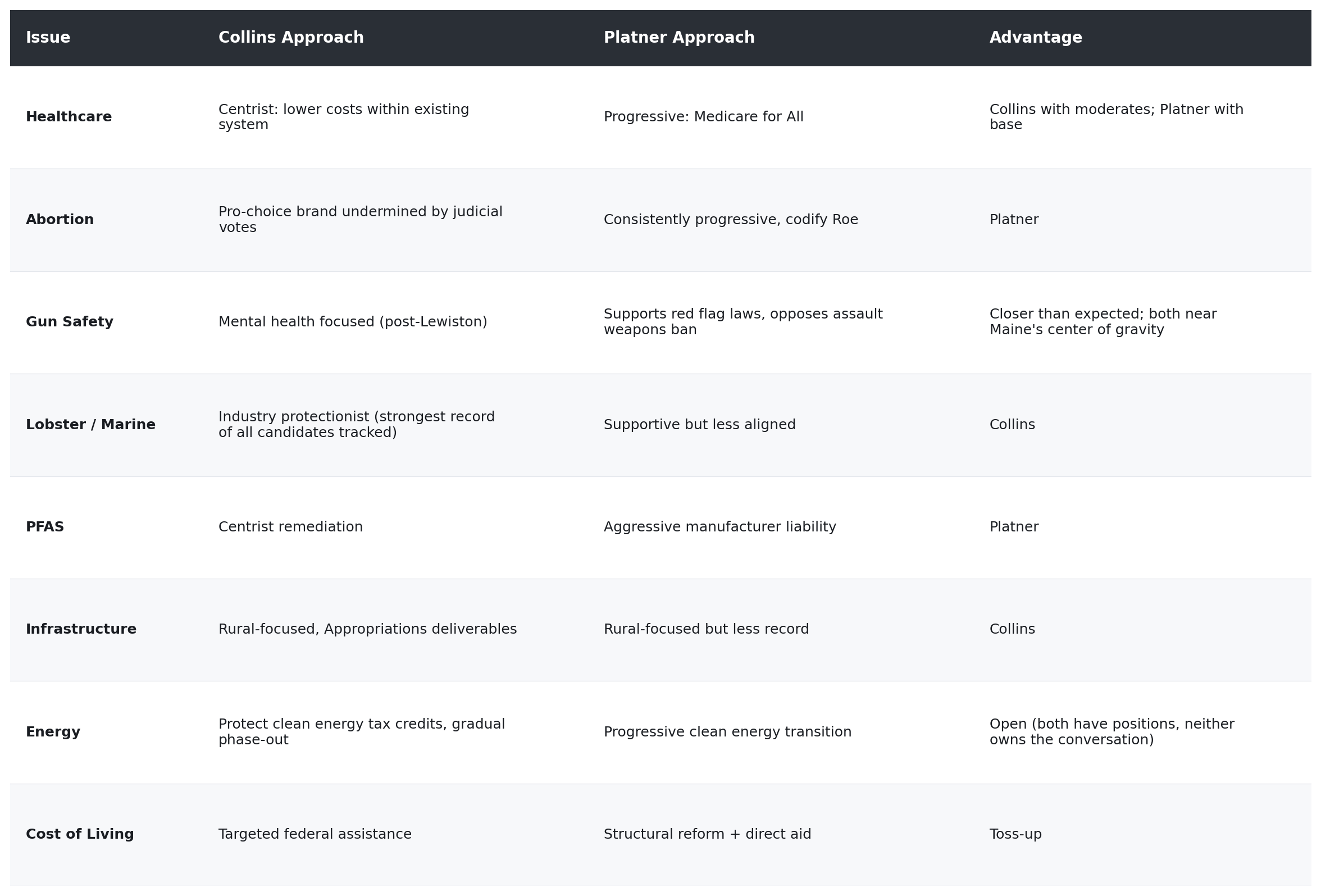
PharosGraph's position analysis reveals that Collins and Platner are often equally engaged on the same issues but arrive from very different ideological directions. The "Advantage" column below reflects three factors: how closely each candidate's stated position aligns with the dominant voter sentiment PharosGraph detects in Maine news coverage and public discourse; the depth and consistency of their public record on the issue; and whether independent verification of their legislative or campaign activity supports or contradicts their positioning. Where both candidates are similarly aligned or where neither has broken through in the public conversation, the advantage is listed as open or shared.
The Race Ahead: Key Dynamics to Watch
- Can Platner survive his own baggage? Mills' exit consolidates Democratic support behind Platner, but the controversies that dogged him during the primary won't disappear. Collins' campaign will almost certainly center opposition research on Platner's personal history. Whether Platner can redirect the conversation to affordability and healthcare will determine his ceiling with swing voters.
- The Kavanaugh question. Collins' judicial confirmation votes remain her most exploitable contradiction. Platner has already demonstrated willingness to attack on this front. In a state where reproductive rights are a top-6 issue and a turnout driver, this could be the single most consequential line of attack in the race.
- CD-2 is the battleground. Maine's 2nd Congressional District, more rural and economically stressed, is where this race will be won or lost. Collins' infrastructure deliverables and lobster industry record play well here. Platner's working-class identity and energy cost messaging could counter.
- Energy prices as a sleeper issue. Both candidates have energy positions, but neither has yet dominated the conversation. Collins broke with her party to protect clean energy tax credits; Platner pushes a broader progressive clean energy transition. With CMP rate hikes and the data center moratorium keeping energy on the front page, whichever candidate makes their position more visible to voters may gain a meaningful edge.
- The unaffiliated middle. With roughly 36% of Maine voters unaffiliated, this race will be decided by independents. Collins' pragmatist brand was built for this electorate. Platner's populist economics could appeal, but his controversies create drag. The candidate who holds the center on cost of living, healthcare, and energy without alienating their base will have the advantage.
Bottom Line
Collins enters the general election with significant structural advantages: incumbency, Appropriations power, a proven bipartisan brand, and dominance on lobster and infrastructure. Her abortion record is a genuine vulnerability, and on housing and energy she has strong legislative records that haven't yet broken through to voters. A disciplined challenger could exploit both the real gap and the messaging gaps.
Platner has the right message on affordability and reproductive rights for a state trending younger and more progressive in its southern half. But his personal controversies are a ceiling on his appeal, and while he has positions on housing and guns, they lack the legislative specifics Collins can point to. On infrastructure, he has almost nothing. Those gaps leave openings Collins will use.
Mills' exit simplifies the race but does not settle it. This will be one of the most closely watched Senate contests in the country.
Go Deeper
This brief is a snapshot. Behind it, RaceScape projects every issue and every candidate's position across all 1,174 census block groups in Maine, updated weekly. That means candidate affinity scores, issue salience, and voter sentiment mapped to neighborhoods, not just counties or congressional districts.
See the data. Explore interactive maps of issue salience and candidate alignment at block group resolution. Request a live demo at info@pharosgraph.com.
Activate it. RaceScape intelligence connects directly to targeting. Build audiences by issue, candidate affinity, and geography down to the block group level — ready for digital, mail, and field programs.
Get a full briefing. Contact us at info@pharosgraph.com for a custom analysis of any race, issue, or geography.
Analysis powered by PharosGraph RaceScape. Data from weekly run of April 23, 2026, supplemented by independent research. Issue rankings, candidate position scores, opposition research, and voter perspective analysis are generated through PharosGraph's analytical engine processing news coverage, candidate records, and demographic data at census block group resolution.


The Suburban Bloc That Could Swing the 2026 Texas Senate Race

What Local TV Ad Sales Teams Are Missing in Political