The State of the Union and the Hidden Axis of Power

The State of the Union and the Hidden Axis of Power
Every president tells you who they think deserves power. Most people aren’t listening for it.
American politics looks like a fight between left and right. It isn’t or at least, that’s not the fight that matters most. Beneath the partisan divide runs a deeper fault line: who holds power, and what makes it legitimate?
Some voters trust structured authority; institutions, expertise, and procedural order. Others believe legitimacy flows upward from ordinary citizens, and that challenging entrenched power isn’t just acceptable, it’s necessary.
This is the vertical-horizontal axis. And it has become the defining dynamic of American politics cutting across both parties, present in every competitive district, and largely invisible in conventional analysis.
The State of the Union is where presidents reveal which side they’re standing on. We built the tools to track it.
What We Measured and Why It Matters
PharosGraph maintains a longitudinal archive of every State of the Union address from Franklin Roosevelt to the present. For each address, we code every actor a president names - individuals, institutions, countries, social groups and classify them as hero, villain, victim, or neutral.
From that data, we track two signals:
Authority minus care. Does the president lean on hierarchy, command, and institutional order or on protection, fairness, and shared responsibility? The balance between these two tells you how power is being justified.
“We” versus “I.” Is presidential power framed as collective or personal? This sounds simple. It isn’t.
These aren’t academic metrics. They are a real-time map of the legitimacy terrain that every political actor, candidate, strategist, communicator is navigating right now.
The Long Arc: From Command to Inclusion
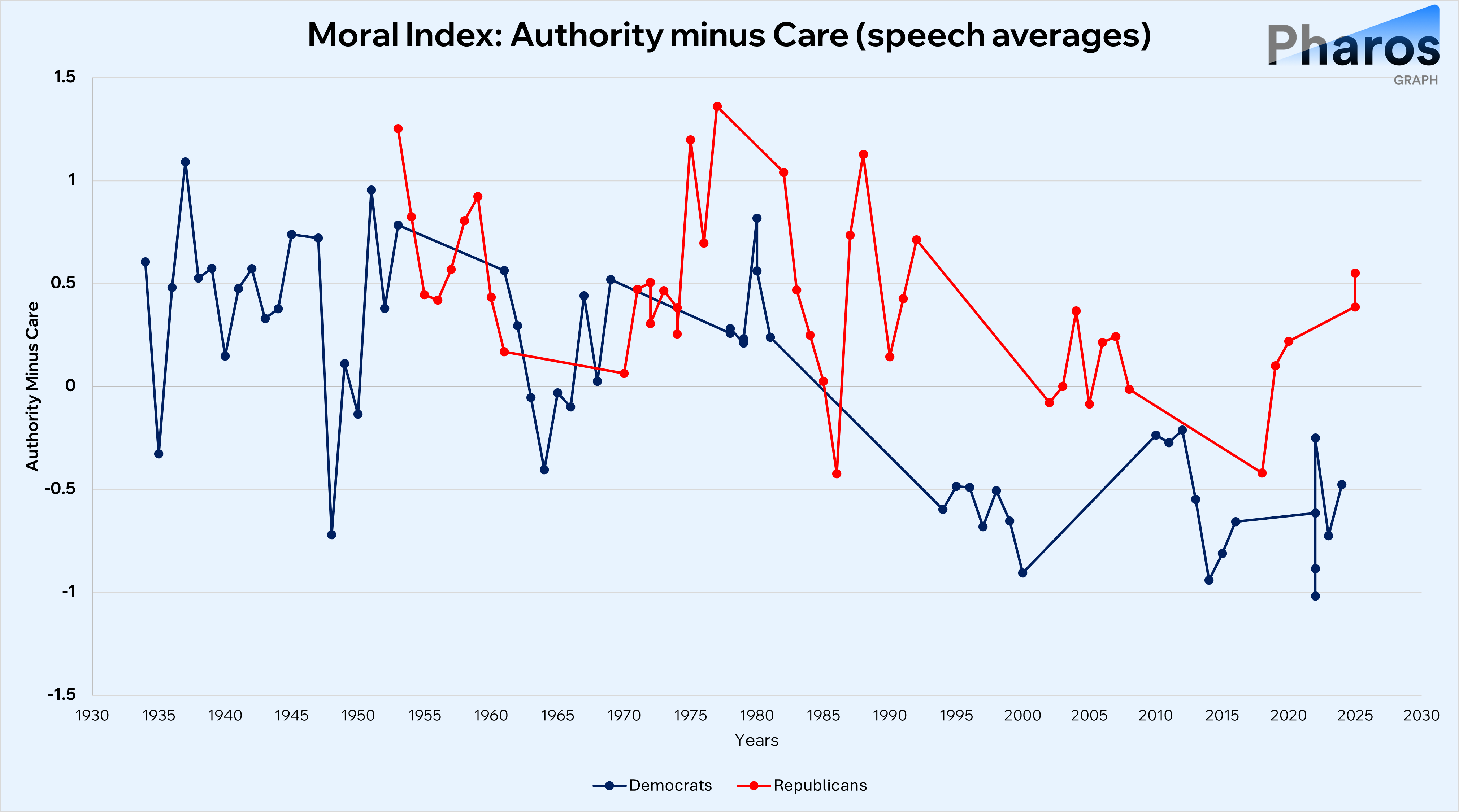
From Roosevelt through the early Cold War, authority dominated. Presidents asserted institutional power with confidence, and the public accepted it. Trust in government was high. In our data, institutions appear overwhelmingly as heroes or neutral stewards. Conflict pointed outward at foreign adversaries, economic threats not at government itself.
That started shifting in the 1990s.
Under Clinton, and more decisively under Obama, care-based language overtook authority. Legitimacy stopped being about command and became about inclusion, fairness, and opportunity. This wasn’t accidental. Gallup and Pew data from the same period shows collapsing confidence in Congress and widening partisan splits over institutional competence. As trust fell, rhetoric adapted. Authority didn’t vanish, it just had to justify itself differently.
Then the Pattern Broke
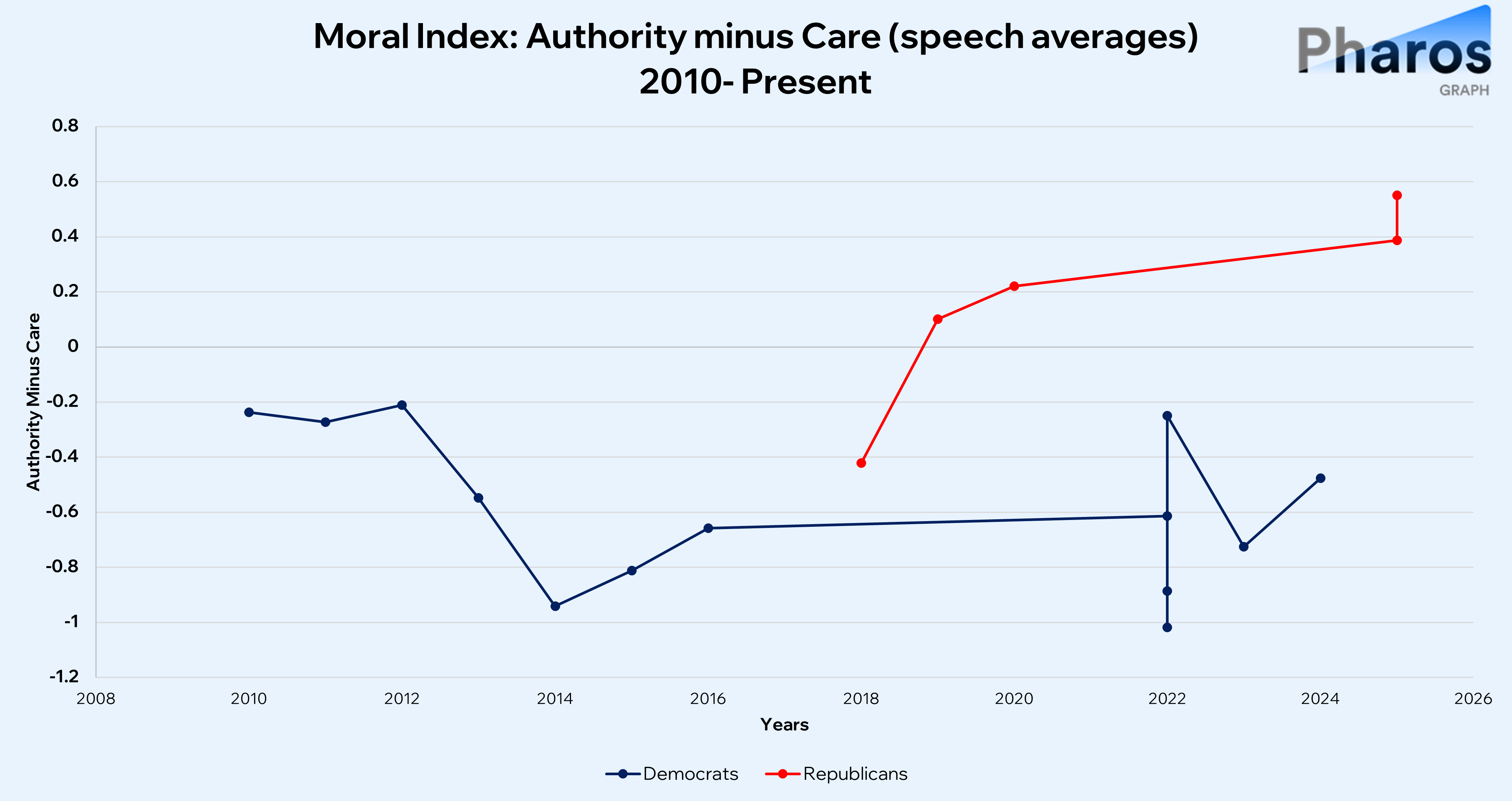
Under Obama, the care-dominant pattern held steady. Collective framing was strong, legitimacy was pluralistic, and authority-minus-care stayed consistently negative.
Then came Trump.
Our data shows authority-minus-care rising sharply at times turning positive. But this wasn’t a return to mid-century institutionalism. The actor coding tells you why: villain density spiked. Authority language operated inside a narrative where institutions were depicted as captured or corrupt. The vocabulary of order and command was being deployed in service of distrust.
Under Biden, the pendulum swung back. Care returned, institutions were defended, authority-minus-care turned negative again.
By 2025, authority surged once more, a sharp upward movement accompanied by intensifying villain construction.
Here’s why that’s historically unusual: authority-heavy rhetoric has typically peaked during wartime or periods of high institutional trust. A resurgence of authority framing in a low-trust, non-wartime environment has no real precedent in ninety years of data.
Governance is being framed less as stewardship and more as assertion. Legitimacy is being claimed rather than built.
The Most Revealing Word in Politics
Every president in our dataset has preferred “we” over “I.” The we-share metric is consistently high across parties, eras, and contexts.
But consistency in usage masks a profound shift in meaning.
Under Roosevelt, “we” meant a nation mobilized, a country at war, pulling together. Under Clinton and Obama, “we” conveyed a pluralistic civic community, diverse, inclusive, forward-looking. Under Biden, “we” emphasized shared protection.
Under Trump, “we” frequently defined a collective against internal adversaries.
This distinction is strategic, not semantic. When authority dominates, “we” reinforces order. When care leads, “we” emphasizes inclusion. But when authority rises alongside elevated villain density, “we” shifts from unity to mobilization, a coalition defined as much by what it opposes as what it supports.
If collective framing narrows or personalizes during a midterm cycle, that isn’t a stylistic choice. It’s a measurable signal that the nature of presidential authority has fundamentally shifted.
The New Legitimacy Crisis
Mid-century presidents grounded legitimacy in structured authority. Late-century presidents grounded it in care and relational governance. Today’s presidency oscillates between both in a trust environment that makes neither approach stable.
Our data shows significantly greater volatility in authority-minus-care after 2010 than in any prior decade. Villain density rises as legitimacy becomes more polarized in narrative terms. And crucially, authority hasn’t returned in the form it held in the 1940s. It now operates inside an electorate divided over a fundamental question: do institutions deserve trust, or do they require correction?
That is the defining divide of contemporary politics. Not left versus right alone but vertical versus horizontal, cutting across both parties.
As Richard Heinberg argues in Power: Limits and Prospects for Human Survival, authority is not self-validating. It depends on social acceptance. When legitimacy fragments, power must either rebuild consent or rely increasingly on assertion. The oscillation in State of the Union rhetoric is that constraint playing out in real time.
The Strategic Challenge No One Is Talking About
PharosGraph’s data doesn’t point to a permanent return of authority dominance or a stable continuation of care-based legitimacy. It reveals something more significant: authority and care are both now operating inside a low-trust environment where institutional legitimacy is uneven and that changes everything.
In earlier eras, authority worked because institutions were broadly trusted. In later decades, care-based legitimacy could anchor governance as trust declined. Today, neither is sufficient alone. Authority without trust looks coercive. Care without structural grounding looks weak. And the electorate is watching for both failures simultaneously.
For anyone in politics, communications, or strategic analysis, here is the operational reality:
- How you frame authority as institutional competence or personal assertion determines which voters you activate and which you lose
- The balance between authority and care in your messaging is a strategic variable, not a stylistic preference
- Vertical-oriented voters seek competence, order, and stability. Horizontal-oriented voters seek accountability and disruption of entrenched systems. Both exist in both parties. Both are present in every competitive district
- Managing legitimacy across both orientations is now a core strategic challenge not a niche concern
- When rhetoric drifts too far toward assertion, or too far toward accommodation, relative to the actual trust environment that drift is detectable, and it costs votes before anyone realizes what happened
PharosGraph’s authority-minus-care balance, actor role distribution, villain density, and we-versus-I ratio give political actors a measurable signal of how power is being positioned at any given moment.
That signal is available. The question is whether those in power are paying attention.


The Suburban Bloc That Could Swing the 2026 Texas Senate Race

What Local TV Ad Sales Teams Are Missing in Political