The Georgia-14 Run-off has a Warning for Both Parties and a Playbook for November
Clay Fuller won Marjorie Taylor Greene's old seat. But the margins tell a story neither side should ignore
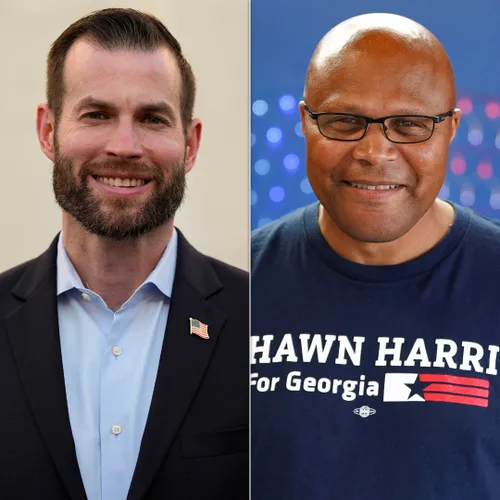
On April 7, Republican Clay Fuller defeated Democrat Shawn Harris 57–43 in the runoff to replace Marjorie Taylor Greene in Georgia's 14th Congressional District. The Republican won. That was expected in a district Trump carried by 37 points in 2024.
What wasn't expected was the margin. Harris's 43% represents a 25-point swing toward Democrats compared to the 2024 presidential baseline, the largest Democratic overperformance in any House special election since Trump took office. In a district rated R+19, a retired Army brigadier general with a fraction of his opponent's ad spending came within 12 points of flipping a seat most analysts had written off.
The question isn't whether Fuller won. It's why he only won by 12 in a district built for 30.
PharosGraph analyzed this race across six dimensions (issue positioning, demographics, media coverage, prediction markets, moral messaging, and narrative framing) covering over 500 census block groups, more than 20 issues, and all 21 original candidates. The data tells a clear story about what worked, what didn't, and what both parties should learn before November.
The Race at a Glance
Here's how the two runoff candidates compared across PharosGraph's key dimensions heading into the race:
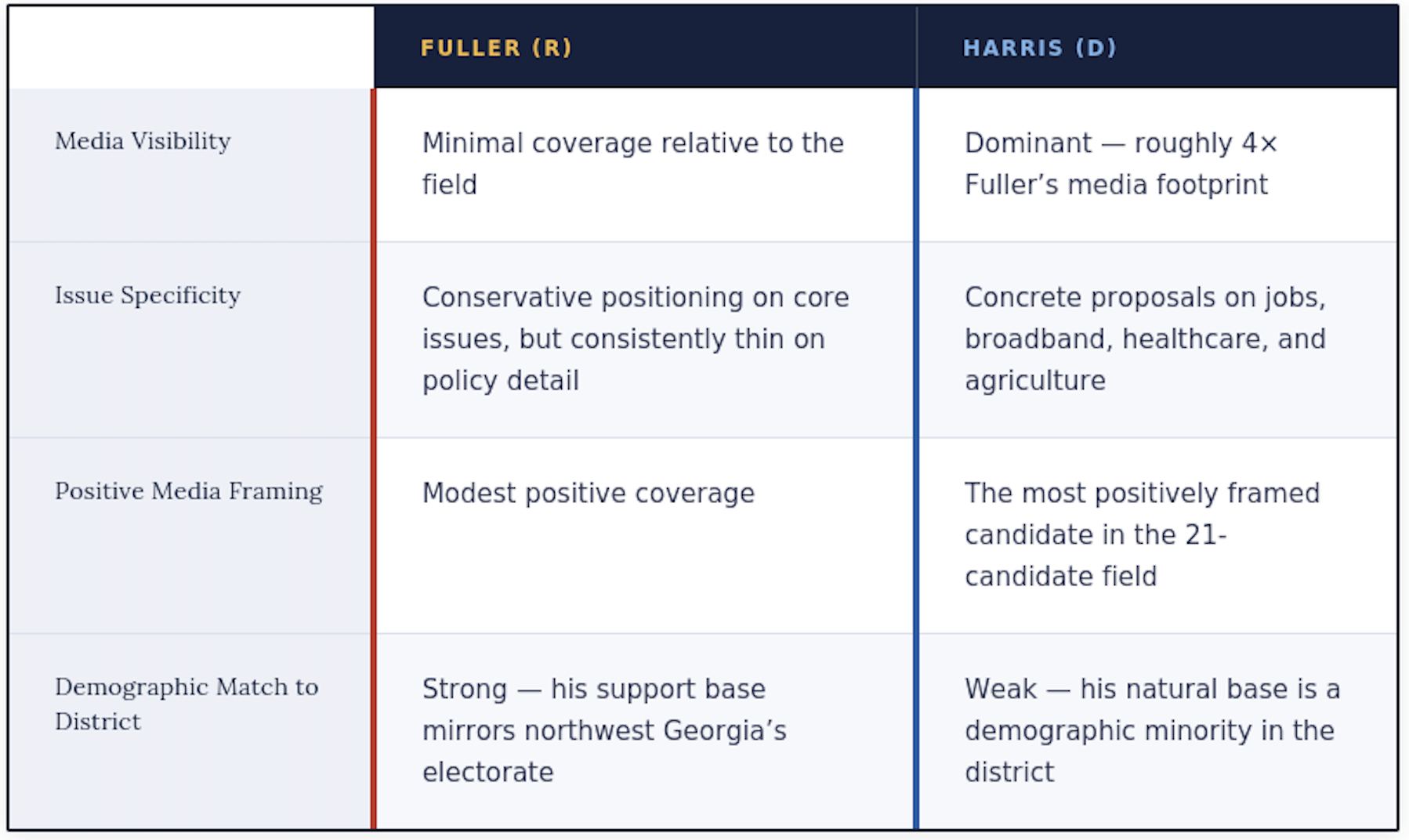
Fuller won because the district's demographics are overwhelmingly Republican. Harris closed a 25-point gap because he won on everything else.
What Worked for Harris and What Democrats Should Study
Harris ran a campaign that defied the conventional wisdom about red-district races. Three things stand out.
He competed on Republican issues. The top concerns in GA-14 are immigration, inflation, crime, and energy costs, issues where Republicans traditionally hold the advantage. Harris didn't cede that ground. He staked out centrist positions on crime and public safety, offered specific proposals on jobs and workforce training, and leaned hard into agriculture and rural infrastructure, the pocketbook issues that matter in a district where farming and small-town economies are daily life, not talking points. Rather than running a national Democratic playbook, he ran a local one.
He earned media coverage instead of buying it. Harris raised $6.4 million but spent only $1.1 million on ads, while Fuller and Republican groups spent $4 million. Yet Harris generated far more media coverage. A retired one-star general running in deep-red territory was a compelling story, and journalists covered it. His military biography gave the media a natural positive narrative, the brigadier general coming home to serve, and that framing carried from March through the runoff.
His messaging connected on empathy and protection. PharosGraph measures how candidates frame their arguments across dimensions of moral reasoning: empathy, fairness, loyalty, authority, and others. Harris's messaging consistently activated empathy and protection themes across a wide range of voter groups, including younger voters, renters, non-white communities, and moderate-turnout neighborhoods. Fuller's messaging was strongest on authority and loyalty, effective with the base but narrower in reach. Harris didn't just talk about different issues. He talked about them in a way that resonated with people who don't usually feel spoken to by Democrats in rural Georgia.
What Should Worry Republicans and What They Can Fix
Fuller won. But the 25-point swing is the seventh consecutive special-election overperformance for Democrats since 2024. That's a trend, not an anomaly. The data points to three specific vulnerabilities.
Endorsement without substance has a ceiling. Fuller's campaign leaned heavily on Trump's backing, and it worked. It consolidated a fragmented Republican field where 15 candidates had split 60% of the March vote. But our analysis flagged a recurring weakness in Fuller's profile: across nearly every major issue, the most common finding was "lacks detailed specific proposals." His persuasiveness and issue clarity scores trailed Harris's consistently. The endorsement got him the win. It didn't get him the blowout that the district's lean should have delivered. In a district where voters are feeling inflation and energy costs daily, alignment signaling is not the same as policy substance.
Ceding the economic narrative is dangerous. GA-14's top voter concerns are pocketbook issues: inflation, energy costs, jobs. Harris competed directly on this terrain with specific proposals, including workforce training programs, rural broadband investment, and small-business support. Fuller offered broad conservative framing but less detail. When voters are anxious about gas prices and grocery bills, "I stand with the president" is a starting point, not a closing argument. Republicans have a natural advantage on economic messaging in districts like GA-14. But advantages that aren't backed by specifics can erode quickly when the economy is under pressure.
When voters are anxious about gas prices and grocery bills, "I stand with the president" is a starting point, not a closing argument.
The media story matters, even in safe seats. Fuller had the endorsement, the spending advantage, and the structural lean of the district. Harris had the story. And in a lower-turnout special election (March turnout was only 31% of 2024 levels) the candidate who generates organic coverage and enthusiasm has an outsized advantage. Republicans can't control how journalists cover races. But they can invest in earned media strategies that go beyond paid advertising and presidential endorsements.
The Pattern Behind the Numbers
When we analyzed eighteen March primaries across four states and nearly 100 candidates, we found that the dimensions that predict Republican winners are fundamentally different from the ones that predict Democratic winners:
- Republican primaries reward media visibility, issue clarity on base priorities, and combative positioning.
- Democratic primaries reward positive media framing, empathy-driven messaging, and building coalitions around education and turnout patterns.
The GA-14 jungle primary was already a cross-party contest, with all 21 candidates on the same ballot regardless of party. It functioned more like a general election than a traditional primary. The runoff made that dynamic explicit. In both rounds, each party's pattern held. Harris's positive framing and empathy messaging, the Democratic winning formula, drove the overperformance. Fuller's demographic alignment and base consolidation, the Republican structural advantage, delivered the win. The margin landed exactly where you'd expect if both forces were real.
This has direct implications for November. In competitive districts, the candidate who combines both sets of strengths (base alignment and issue substance, demographic fit and broad moral appeal) will have the edge. In safe districts, the candidate who only plays to the base may find the margin uncomfortably narrow.
What Both Sides Should Take From GA-14
For Republicans: The structural advantage in red districts is real but not self-executing. Candidates who pair Trump's endorsement with specific, locally relevant policy proposals will hold margins. Candidates who rely on alignment alone risk seeing 25-point swings become 30-point swings if economic pressures intensify. The lesson for candidates already on the ballot: lead with what you'll do on the issues voters care about most, not just where you stand in the party hierarchy.
For Democrats: Harris's campaign is a template for competing in hostile territory. Compete on local economic issues. Earn media coverage through biography and story, not just spending. Frame arguments around empathy and protection, not ideology. And don't underestimate the power of field organizing: Harris's investment in on-the-ground infrastructure rather than relying solely on ad spending helped him reach voters who rarely hear from Democrats in person. Harris didn't flip GA-14, but he proved that a 37-point Trump margin isn't a fixed number. It's a starting point that the right candidate with the right strategy can compress dramatically.
For both: The voters in the middle, the ones who created the 25-point swing, aren't responding to partisan signaling from either side. They're responding to specificity, authenticity, and candidates who address their daily economic reality. The party that figures out how to do that consistently will define the 2026 cycle.
PharosGraph analyzed the GA-14 special election race across over 500 census block groups, more than 20 issues, and 21 candidates using our six-dimensional RaceScape model. For race-level analysis and voter targeting data, contact info@pharosgraph.com.


The Suburban Bloc That Could Swing the 2026 Texas Senate Race

What Local TV Ad Sales Teams Are Missing in Political