(UPDATED) A Slow Burn Met a Spark: How Five Weeks Reshaped Voter Anxiety on the Economy

The Through-Line
In late February, economic pressure was already real for millions of Americans: persistent inflation, stagnant wages, the daily friction of groceries and gas costing more than they should. But it was a slow burn, spread across disconnected grievances with no single cause to point to.
Then, on February 28, the United States entered a military conflict with Iran. Oil prices spiked, inflation projections were rewritten overnight, and the scattered economic pressures voters had been absorbing suddenly had a catalyst, a timeline, and a direction: worse.
Over five weeks, the data tells a consistent story across every dimension: a war took economic pain voters were already living with and compounded it into a multi-front crisis. And the voters who responded most intensely were not Republicans or Democrats. They were independents.
Before the War: Real Pain, No Focal Point
Week of February 23
Economic policy registered at a voter engagement score of 53, present but not dominant. The stories in circulation were fragmented: "Persistent Inflation Threatens Economy," "Economic Anxiety and Stagnation," and "Mortgage Rates Fall Below 6%." Each pointed in a different direction. No single narrative organized the issue.
Economic Policy Voter Engagement: 53 — The issue leaned Republican (56) over Democrat (51), but the gap was modest. The standout signal was independents at 72, fifteen points above Republicans and twenty-one above Democrats.
Beyond engagement, the data tracks two additional dimensions. The first is the emotional tone of media coverage. This is not what voters say they feel, but the emotional environment created by the stories they consume. In late February, that environment was frustrated but not panicked. Anxiety led, but anger was close behind and hope was still meaningfully present. The framing was about fairness: "is this fair?", "who's cheating?"
The second is what we call narrative roles: the people, institutions, and groups that coverage names as heroes, villains, and victims of the story. In late February, the roles were sparse, with the Bureau of Labor Statistics (BLS) as a modest hero and the Trump administration as the primary villain. The economic story had plenty of pain, but no plot.
The Shock: Iran Changes the Narrative Equation
Week of March 2
The U.S.-Iran conflict began on February 28. Oil prices surged, supply chains seized, and inflation that had already been squeezing household budgets found a new accelerant. Coverage volume nearly tripled. Three new stories appeared at maximum engagement potential: "Iran War Inflation Crisis," "War-Driven Inflation and Economic Crisis," and "Court Orders Tariff Refunds."
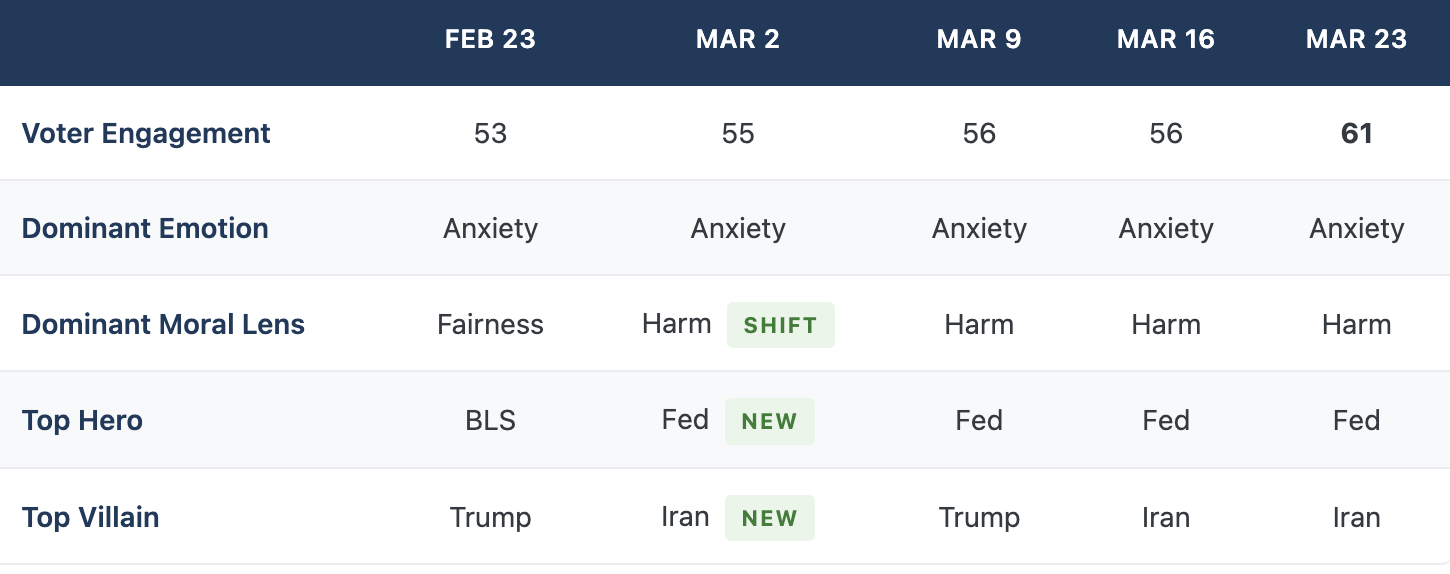
The emotional tone shifted sharply. In a single week, anxiety jumped by nearly a quarter and fear, which had been secondary, surged by more than half. Hope was cut nearly in half. The balanced mix of late February collapsed into something far more negative. The moral framing changed with it: coverage stopped asking "who rigged this?" and started asking "who is being hurt?" The fairness lens gave way to one centered on harm.
The narrative roles more than doubled. Iran appeared as the top villain, instantly overtaking the Trump administration. The Federal Reserve (the Fed) stepped into the hero role for the first time. And the victims shifted from broad labels like "American companies" to personal ones: consumers, workers, homebuyers.
Democrats surged into the conversation, narrowing the partisan gap. Independents held near their pre-war level, remaining the most engaged group throughout the disruption and reinforcing their sensitivity to economic pressure regardless of what was driving it.
Deepening: The New Shape Holds
Weeks of March 9 – 16
Over the next two weeks, the war's economic fallout did not fade. It settled in. Engagement climbed roughly a point per week. Democrats and Republicans were now engaged at nearly identical levels, with most of the partisan gap eliminated. Independents resumed their climb, reaffirming their position as the most responsive audience.
The stories matured. By March 9, all top stories were war-linked, including "Mortgage Rates Spike from Iran War," an inversion of the positive mortgage story from three weeks earlier. By March 16, coverage broadened in two directions. War-driven stories expanded to include oil prices and global inflation. But a separate domestic thread also entered the economic narrative: a TSA slowdown driven by the congressional fight over Department of Homeland Security (DHS) funding and ICE. This was not related to the war, but it added a parallel source of economic disruption that compounded the pressure voters were already feeling.
The emotional tone locked into its new shape. Anxiety and fear held at their elevated post-war levels while anger steadily retreated, falling back to roughly where it was before the war. Anger in coverage drives blame narratives; anxiety drives protection narratives. The economic story was transitioning from one to the other. The moral framing tracked the same shift, with harm and care holding the top positions as coverage turned toward institutions for answers.
The narrative roles reflected that institutional turn. The Fed's framing as a hero increased substantially, making it the central stabilizing figure in the economic story. The victims fragmented into specific identities: homebuyers, homeowners, investors, workers. The economic toll was becoming personal.
The Breakout: Compounding Pressure
Week of March 23
Then the week of March 23 broke the pattern.
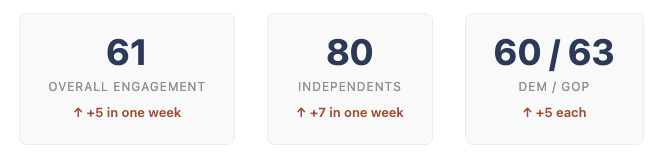
Engagement surged five points in a single week, nearly matching the entire prior three-week climb combined. Both parties rose equally, but independents outpaced everyone at +7, reaching 80. The independent sensitivity visible from the very first week had reached its fullest expression to date.
The stories explain it. Four stories at maximum engagement potential, each targeting a distinct household pressure: war-driven inflation (prices at the register), market volatility (retirement savings), a mortgage rate crisis (housing costs), and continued Iran conflict fallout (jobs and supply chains). The economic story didn't suddenly become real this week. It had been real all along. What changed is that the pressures compounded, hitting from multiple directions at once.
Anxiety climbed to a new five-week high, the only emotional dimension still rising. The harm/care moral framing held. The narrative roles expanded dramatically, with the number of named actors roughly doubling from prior weeks. The Fed's hero framing intensified further, now flanked by global institutions like the European Central Bank (ECB) and the Organisation for Economic Co-operation and Development (OECD). Iran dominated the villain role more than ever. Separately, Congress emerged as a prominent villain, driven largely by the DHS funding fight and its impact on TSA workers rather than the war itself. The economic narrative was now being fed by two distinct sources of dysfunction: a foreign conflict driving inflation and a domestic political standoff disrupting government services.

The Full Arc
The U.S.-Iran conflict did not create economic pain. That was already there. What it did was escalate, unify, and compound it. Scattered pressures converged. A slow burn became a fast one. And by March 23, a second source of pressure, the congressional fight over DHS funding, had layered domestic government dysfunction on top of wartime inflation, creating a multi-front economic crisis with no single resolution in sight.
Every dimension of the data shifted in the same direction: the moral framing moved from "is this fair?" to "who is being hurt?", the emotional tone moved from anger to anxiety, the Fed replaced statistical agencies as the hero, Iran and Congress replaced domestic politicians as the villains (for different reasons), and the victims shifted from broad categories to specific households.
One signal has been consistent from the first week through the last: independents are the most engaged audience for this issue, by a wide and growing margin. They started at 72. They are now at 80. The conflict amplified what was already there. Economic pressure was an independent-voter issue before a single missile was fired.
As of late March, engagement was accelerating, testing how far a single narrative frame could push voter activation before something had to give.
Five weeks ago, voters were shouldering economic pressure and the coverage was looking for someone to blame. Now they are shouldering more of it, from more directions, and the coverage is looking for someone to help. That shift, from grievance to need, is what the data is tracking. And as of this week, it is still underway.
Update: April 14, 2026
The Ceiling, and What Came Next
Two weeks ago, we left this analysis at the end of March with economic voter engagement surging and a single narrative -- the Iran war's economic toll -- driving nearly every story in the topic. We noted that engagement was testing how far one narrative frame could push voter activation. Now we have an answer.
The peak held, then eased. Voter engagement on economic issues plateaued at 61 through the end of March and then pulled back to 55 in the second week of April. The Iran war stories did not go away -- the IMF issued a formal warning that the conflict would slow global growth, and the March CPI showed the biggest monthly inflation jump since June 2022, driven by a record 21.2% surge in gasoline prices. But the sheer concentration of war-economy coverage appears to have found a natural ceiling.
New stories broke through. For the first time since late February, non-war economic stories emerged with real force. Two threads in particular:
- The AI economic threat. A story cluster centered on warnings from figures like Sam Altman and Vinod Khosla that AI could "break the economy" and displace workers at scale. The coverage included radical policy proposals like eliminating income taxes for most Americans and creating public wealth funds, making this as much a solutions story as a threat story.
- Social safety net under pressure. A separate cluster around proposed cuts to Social Security, Medicare, Medicaid, and SNAP, including new SNAP work requirements that have already removed an estimated 2.5 million people from food assistance. This brought domestic policy back into the economic conversation after weeks of war dominance.
The narrative cast diversified. In the roles data, the villain list expanded beyond Iran and the administration for the first time. "Tech-bro profiteers," "AI Oligarchs," and major health insurers entered the frame. Sam Altman became the period's most prominent antihero. And consumers emerged as the dominant victim class by a wide margin, appearing in victim roles more than three times as often as any other group.
Hope is back, modestly, but from identifiable sources. At the height of the crisis coverage, hope nearly vanished from the narrative tone. It has since ticked back up, and we can trace it to three specific threads:
- Ceasefire signals. The IMF story referenced a "fragile ceasefire" bringing temporary relief to some markets. Wall Street strategists noted the ceasefire, even while warning the damage to inflation and energy security was durable.
- Renewable energy as a silver lining. Multiple stories framed the energy crisis as accelerating the transition to renewables. IRENA data showing global renewable capacity nearing 50% and UN arguments that fossil fuel dependence on unstable regions strengthened the case for clean energy introduced a forward-looking angle.
- AI policy proposals. The AI threat story was unusual in that it paired alarm with concrete solutions: wealth redistribution, regulatory action, even a four-day workweek. Threat stories rarely carry this much solution content, and it appears to be contributing to the modest hope recovery.
The moral frame came full circle. In late February, fairness was the dominant moral lens, with voters evaluating whether economic policies were honest and equitable. As the war intensified, harm took over and the frame became "who is being hurt?" In the second week of April, fairness surged back to its highest level since February, running nearly even with harm. The AI and social safety net stories naturally raise equity questions: who benefits from AI, who bears the cost, who deserves protection. The coverage is engaging those questions directly.
Independents remain the signal. Independent voters continued to track well above both partisan cohorts, sitting near 72 in the most recent week. Their engagement eased along with the national trend but remains elevated. As we noted in the original analysis, Independents were the first to engage and the most responsive throughout. They remain the group to watch as the narrative evolves.
What this means. The economic narrative may be entering a new phase. The war established the crisis frame, but the story set is now broader than at any point since we began tracking. Whether this diversification sustains voter engagement or dilutes it will depend on whether the new threads (AI disruption, safety net policy, ceasefire dynamics) develop enough gravity to hold attention alongside the ongoing war-economy pressure. The return of fairness as a moral frame suggests the conversation is maturing from pure crisis response toward something more evaluative, and historically, that is a frame that invites deeper engagement.
From Insight to Action with PharosGraph
The trends above tell you what voters care about and how intensely they care. PharosGraph's IssueScape platform turns that intelligence into targeting strategy. By mapping issue-level engagement data down to the neighborhood level, IssueScape identifies exactly where voters most activated by a given issue live, and which message will resonate based on their dominant concerns. It goes further by factoring in a candidate's position relative to their competitors on that same issue, so you're not just reaching voters who care about the economy — you're reaching the ones in the precincts where your candidate's stance gives them the strongest advantage. The result is a precision outreach strategy built on what the electorate is actually feeling, where they're feeling it, and where your candidate is best positioned to lead the conversation.


The Suburban Bloc That Could Swing the 2026 Texas Senate Race
What Local TV Ad Sales Teams Are Missing in Political